TV host Bob Barker was a member of the Sioux nation


Robert William Barker was an American media personality, game show host, and animal rights advocate. He hosted CBS's The Price Is Right, the longest-running game show in North American television history, from 1972 to 2007. Barker also hosted Truth or Consequences from 1956 to 1975. Born in Darrington, Washington, in modest circumstances, Barker spent most of his youth on the Rosebud Indian Reservation and was a citizen of the Rosebud Sioux Tribe. The U.S. Indian Census Rolls, 1885–1940, list Barker as a citizen of the Rosebud Sioux Tribe, which the tribe publicly confirmed. His mother, Matilda was a schoolteacher; his father, Byron John Barker, was the foreman on the electrical high line through the state of Washington. Barker's father was one-quarter Sicangu, , thus Barker was one-eighth Sicangu. Barker once said, "I've always bragged about being part Indian, because they are a people to be proud of. And the Sioux were the greatest warriors of them all." (via Wikipedia)
In the nineteenth century before libraries women sold books door-to-door
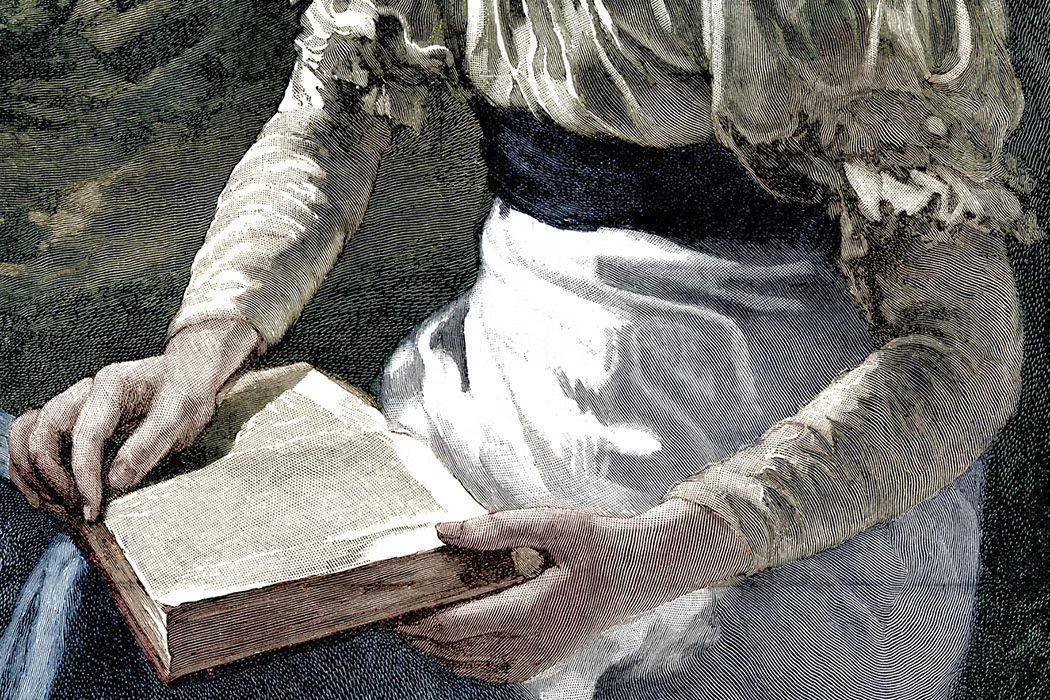
In the second half of the nineteenth century, before the rise of public libraries, many people in remote parts of the United States got their hands on new books thanks to traveling salespeople. The booksellers visited homes and businesses with sample books, took orders, and then later delivered the books and collected payment. Braun writes that popular volumes included Bibles, farming and health manuals, biographies, and fiction. Ulysses S. Grant’s memoirs and the works of Mark Twain were popular choices. Many books published using this “subscription” model sold hundreds of thousands of copies. In an 1868 account of her work selling books across northern Illinois and Indiana, Annie Nelles Dumond described taking up the work out of necessity. She wrote that, seeking to escape a difficult childhood, she married young to a man who turned out to already have a wife and children. A second husband abandoned her. So Dumond sought ways to support herself. When she began selling books, she wore a mourning bonnet. She acknowledged that this was deceptive but wrote that it was “almost necessary to my self-preservation that my past should not be known.” (via JSTOR Daily)
Mobster Vincent Gigante wandered the streets in his bathrobe pretending to be senile

For the latter part of the 20th century, Vincent Gigante, pictured above left, was a household name in his Greenwich Village neighborhood. On any given day, starting when he was in his mid-to-late-30s, Gigante would walk around the community talking to himself under his breath, incoherently, to either no one whatsoever or only to figments that he could see. Sometimes he was wearing old, frayed, and patched pants, paired with a light jacket that had seen many better days. But such formal attire was rare. Gigante was typically seen as above, wearing a bathrobe, pajamas, and slippers, seemingly unaware that it was entirely inappropriate to wear such attire out on the street. The New York Times described his behavior as that of “a disturbed but harmless person" who was obviously out of place. But that’s not why he was famous. He was best known for being a mob boss – the head of the Genovese crime family. (via Now I Know)
Hi everyone! Mathew Ingram here. I am able to continue writing this newsletter in part because of your financial help and support, which you can do either through my Patreon or by upgrading your subscription to a monthly contribution. I enjoy gathering all of these links and sharing them with you, but it does take time, and your support makes it possible for me to do that. I also write a weekly newsletter of technology analysis called The Torment Nexus.
For a brief period in the US it was fashionable to wear a live lizard pinned to your dress
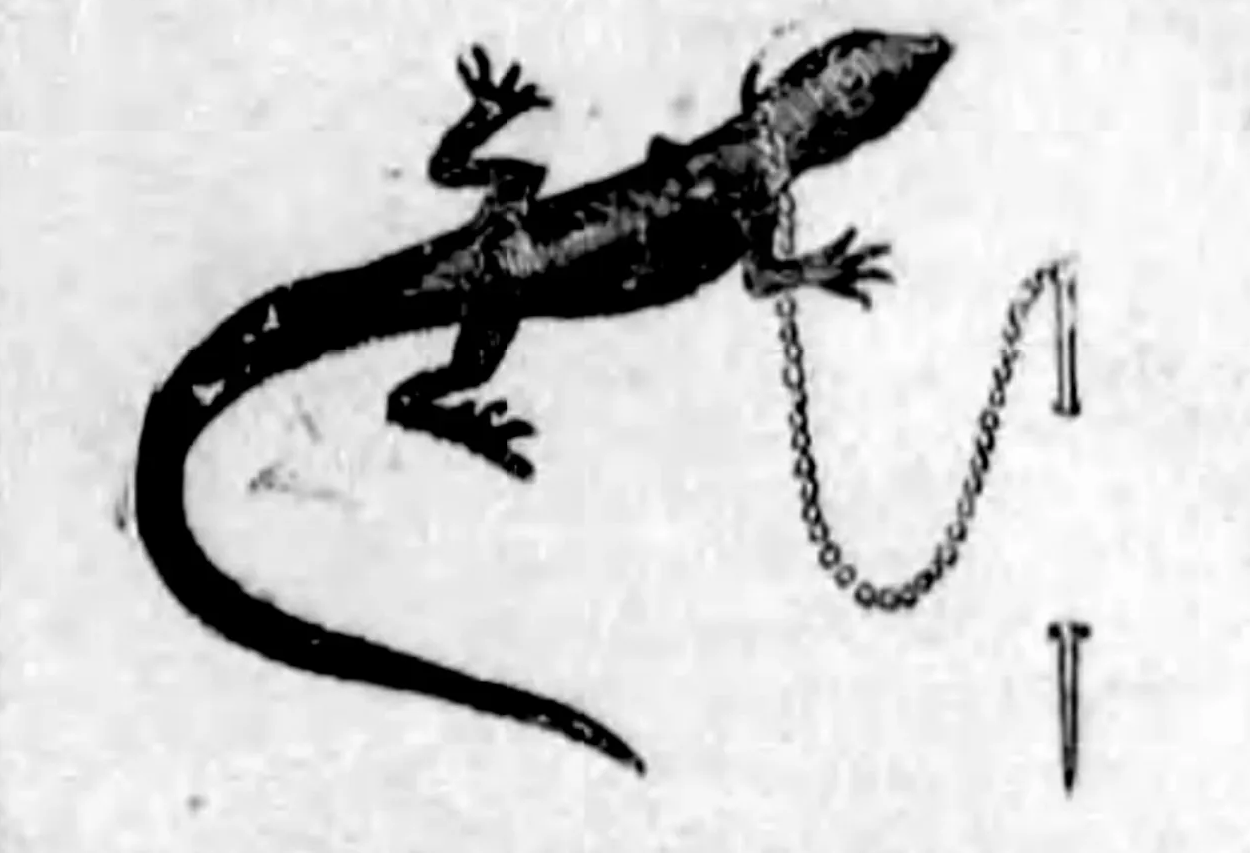
During the winter of 1893-94, department stores struggled to keep a curious item in stock: live “chameleons” imported from Florida and marketed as fashionable jewelry for women. Small green lizards attached to pins with collars and delicate chains were sold as living ornaments and souvenirs to tourists. Within a few years, what had started as a local curiosity would become a nationwide phenomenon. Florida was ground zero for the chameleon craze. During the second half of the nineteenth century, the state had emerged as a popular seasonal destination for affluent Northern tourists. Visitors typically purchased keepsakes to serve as tangible reminders of the state’s distinctive wildlife, including various alligator- and orange-themed curios, scenic photographs and postcards, and decorative silver spoons and china. In 1890, Charles E. Mackay began offering a novel souvenir in his St. Augustine book and stationery shop: “a live chameleon fastened to a gold pin by a slender gold chain,” a kind of “animate breast pen” that was “to be worn in the bosom of a lady’s dress.” (via Wild History)
Research shows the human brain may have originally been two separate organs
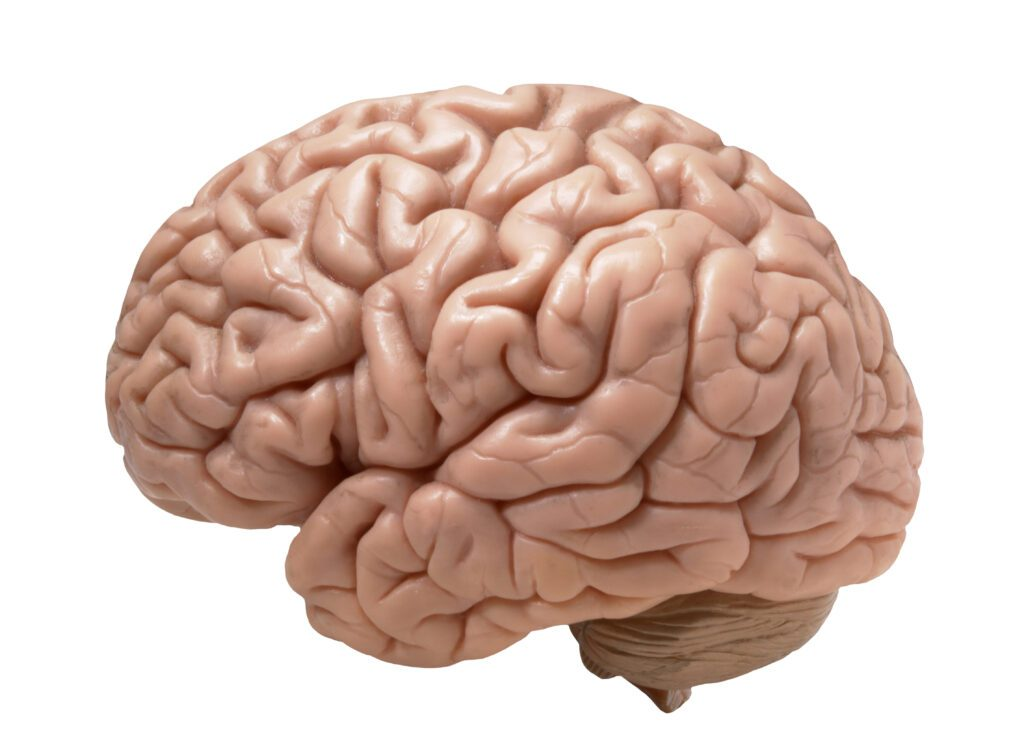
For centuries, scientists have thought of the brain as a single, unified organ. But new research led by Stanford Medicine reveals that what we call the brain is two distinct organs that evolved independently over hundreds of millions of years. The discovery overturns a prevailing model of brain development. For decades researchers have subscribed to the theory that there is a single progenitor cell early in development that gives rise to the entire brain. This model suggested all parts of the brain shared a common developmental origin. The new research finding shows that the human brain consists of two ancient nervous systems cleverly packaged together — a more primitive part that regulates our hearts’ beating, our breathing and other functions, and another that makes us distinctly human, capable of poetry, mathematics and wondering about our own origins. The discovery could help explain why scientists have struggled for decades to grow certain types of brain cells in the laboratory — and it opens new avenues for studying devastating diseases that affect the brain stem, like Amyotrophic Lateral Sclerosis. (via Eureka Alert)
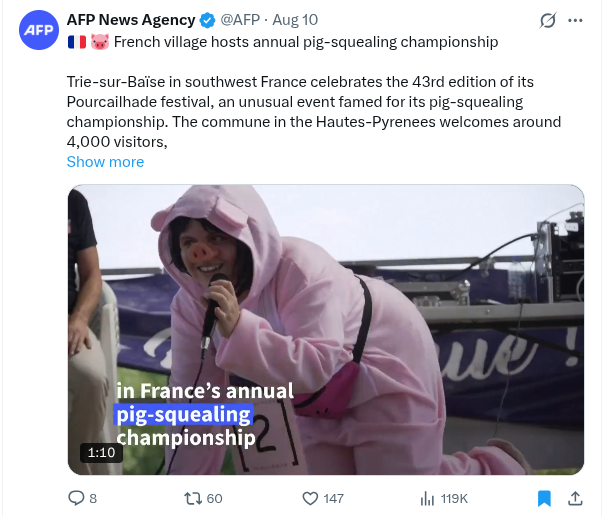
This French village hosts an annual pig-squealing championship
Acknowledgements: I find a lot of these links myself, but I also get some from other places that I rely on as "serendipity engines," such as The Morning News from Rosecrans Baldwin and Andrew Womack, Jodi Ettenberg's Curious About Everything, Dan Lewis's Now I Know, Robert Cottrell and Caroline Crampton's The Browser, Clive Thompson's Linkfest and Why Is This Interesting by Noah Brier and Colin Nagy. If you come across something you think should be included here, feel free to email me at mathew @ mathewingram dot com