Things can get very competitive at the sauna Olympics


He finds the chamomile and tips a couple extra drops onto a white snowball, making the top of it turn blue. Then the door opens, and he walks through it. For the next 15 minutes, Talmadge, 39, will whip a towel through thick, sticky air to push waves of heat and scent toward 200 naked strangers, including a six-person jury. Aufguss is a sauna ritual; a performance is called a set, and the most elite of them combine choreography, scent, storytelling, steam, and stamina. A competitor—known as a sauna master—enters the sauna to music and places a scented snowball on the hot rocks, then disperses its aroma with their towel. For every one of three or four song changes, another snowball goes on the stove. Contestants are forbidden from drinking water, and judges dock points if they appear fatigued. Within the span of his set, Talmage’s heart rate will hit about 195 beats per minute, according to the Whoop he wears on his left wrist. This is the Aufguss Show World Masters. Forty solo sauna masters from 19 nations have come to Satama, a lakeside resort, after qualifying in their national championships. (via GQ)
The six-year quest to find the mystery woman in an 18th-century painting
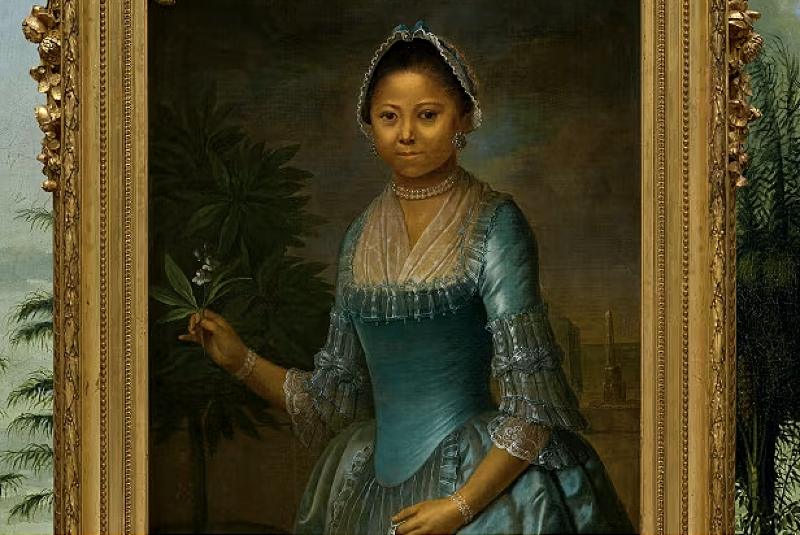
Adam Harris Levine stood before the 18th-century painting, completely stumped. The 30-year-old curator at the Art Gallery of Ontario had been scrutinizing a portrait of a young Black woman bedecked in jewels and wearing a shimmering blue gown with pearls around her neck and wrists. Portrait of a Lady Holding an Orange Blossom — the woman holds a sprig of white flowers in her right hand — hung in the gallery near masterpieces by Rubens and Rembrandt. Yet when Levine first stared at her in 2020, he had no idea who had painted her or who the woman even was. Levine set out to solve the mystery. It led his team to sift colonial-era archives and convince families to share fragile letters revealing ugly histories. Early on, they crowdsourced tips through a podcast, garnering help from amateur genealogists listening in. Today, the Art Gallery of Ontario believes that it knows who its mystery girl is and who painted her — the art-historical equivalent of finding a needle in myriad haystacks. (via the WSJ)
New York City at one time had a single-station subway that was pneumatically-powered
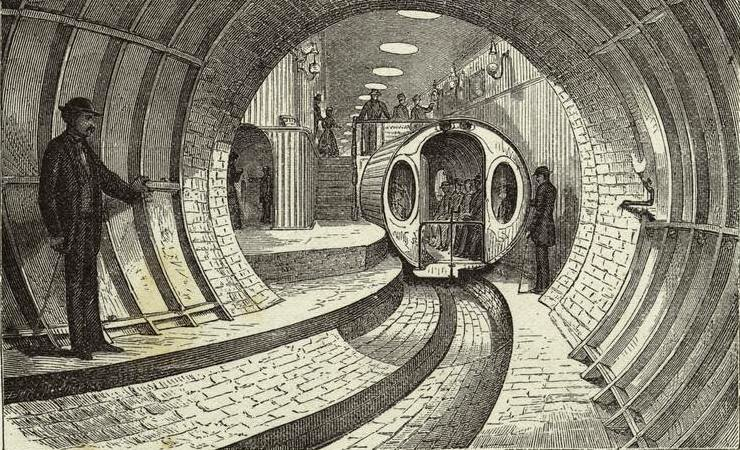
Before the subway we all know was built there was an 1870 demonstration line known as the Beach Pneumatic Transit. Alfred Ely Beach, inventor and editor of Scientific American, had designed a pneumatic (air-driven) system which he demonstrated at the American Institute Fair in 1867. He applied for a permit from the Tammany Hall city government, and after being denied, decided to build the line in secrecy, in an attempt to show that subterranean transit was practical. Operated as a demonstration from 1870 to 1873, the short tunnel had only the one station and train car. While frequently mentioned as an important early development in NYC transit history, it was merely a curiosity. It is unclear that such a system could have been practical on a large scale. Smaller tube systems are used in buildings for mail delivery, but a rail-car sized system has never been developed. The perfection of electric multiple-unit traction and electric locomotives came about so quickly after this experiment that it wasn't deemed worthwhile to even try an expanded pneumatic system. (via NYC Subway)
Hi everyone! Mathew Ingram here. I am able to continue writing this newsletter in part because of your financial help and support, which you can do either through my Patreon or by upgrading your subscription to a monthly contribution. I enjoy gathering all of these links and sharing them with you, but it does take time, and your support makes it possible for me to do that. I also write a weekly newsletter of technology analysis called The Torment Nexus.
Three Elvises, and one pink Cadillac crash: Inside the chaotic world of Elvis impersonators
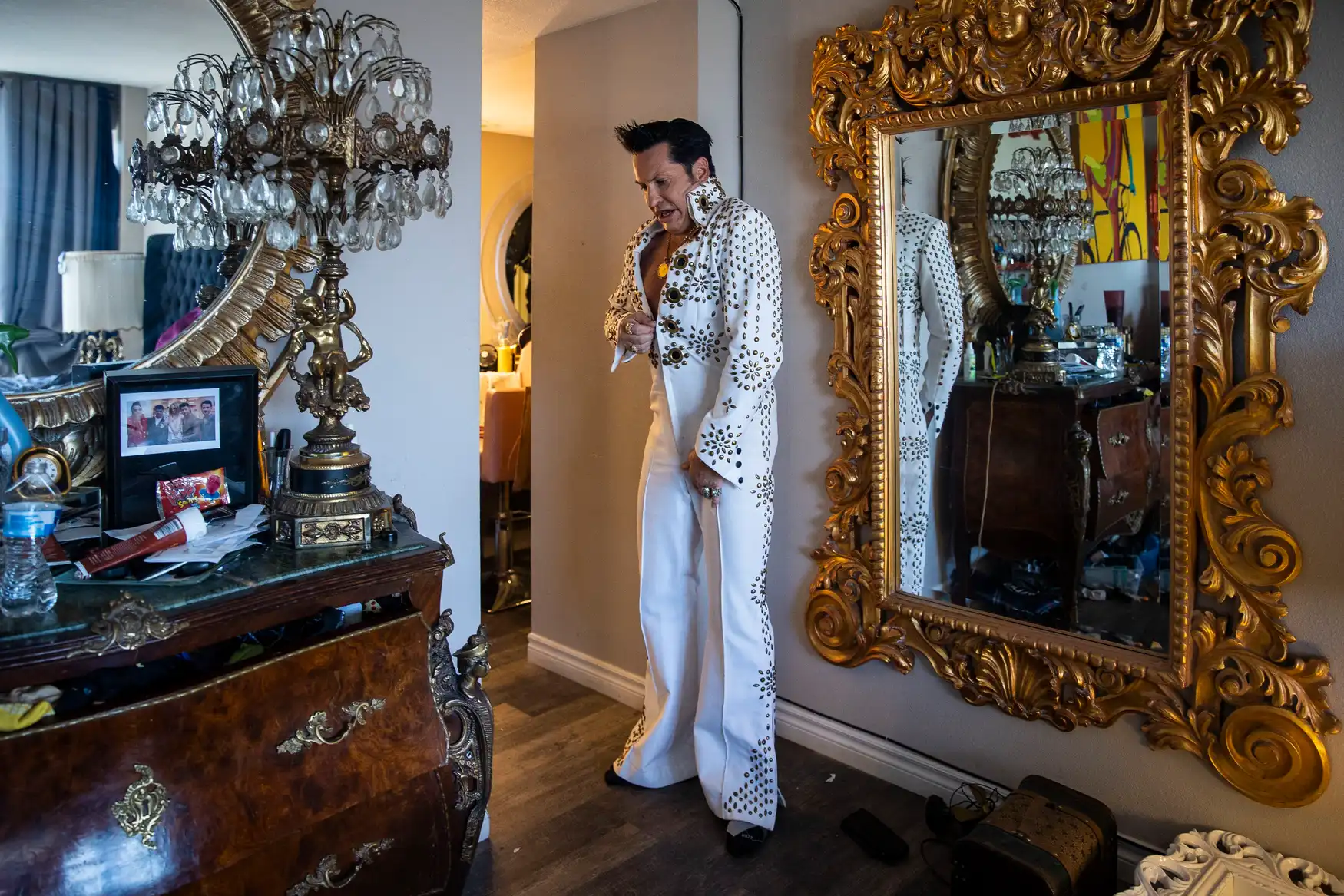
Elvis drives a temperamental pink Cadillac with no seat belts and unreliable brakes. He’s sweating — a lot — and foundation has spread from his face to the lapels of his white jumpsuit. He is running late for an appearance in a Mexican Independence Day parade. This may be my fault. That afternoon, Elvis, né Jesse Grice, had obligingly received us at home, wearing only mesh shorts, so that we could witness his transformation into the King. I apologized for being late. “It’s OK,” he said. “I keep Elvis hours.” Inside his apartment, gilt mirrors shone from almost every surface, so the many pieces of Elvis paraphernalia refracted and seemed to multiply. Above the sofa was a huge shirtless portrait of either Grice or Elvis — at points, the distinction blurs. That evening, Grice was scheduled to chauffeur Las Vegas Councilwoman Olivia Diaz through the parade. So he did a speedy version of his normal routine: heavy foundation (Dermablend, the stuff they use to cover tattoos), hair spray, and waterproof mascara. “I learned from the best,” he explained, “drag queens.” (via the Boston Globe)
Physicists have discovered that gravity can actually collapse the fabric of space-time
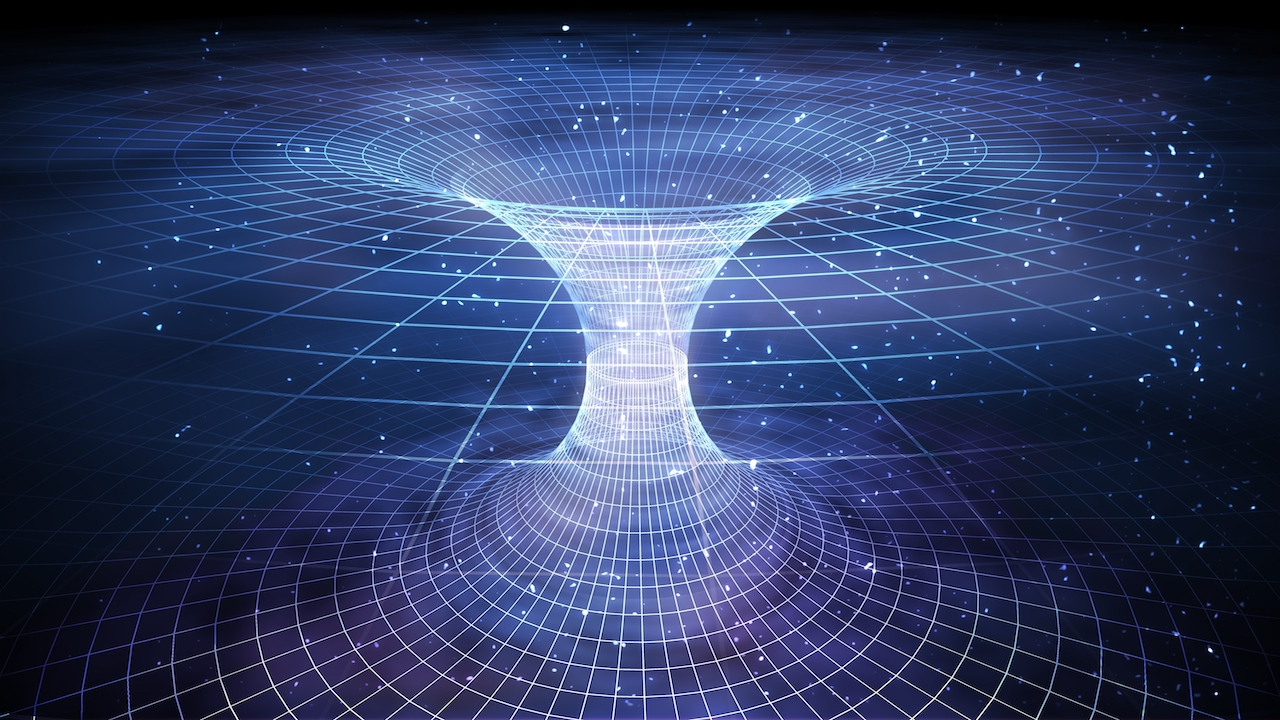
Put a box around any region of space (space-time, really, but I’m going to drop time throughout this essay for ease of visualization, as physicists often do). The holographic principle asserts that no matter what’s going on inside — from gas molecules pinging around to black holes colliding — you can decipher the entire contents of the box just by repeatedly measuring points on the surface. Scientists have known for more than a century that gravity is different from the other forces. Imagine a box filled with electric charges, representing one of the other fundamental forces, electromagnetism. Because positive charges neutralize negative charges, different arrangements can look the same. If you observe no field, it could mean there’s no charge inside — or it could mean that the effects of the positive charges are perfectly blocking the effects of the negative charges. From the surface, you can’t tell the difference. (via Quanta)
Watch the 2026 Hay Bale Toss champion

Acknowledgements: I find a lot of these links myself, but I also get some from other places that I rely on as "serendipity engines," such as The Morning News from Rosecrans Baldwin and Andrew Womack, Jodi Ettenberg's Curious About Everything, Dan Lewis's Now I Know, Robert Cottrell and Caroline Crampton's The Browser, Clive Thompson's Linkfest and Why Is This Interesting by Noah Brier and Colin Nagy. If you come across something you think should be included here, feel free to email me at mathew @ mathewingram dot com