Pittsburgh has an annual Parallel Parking Championship

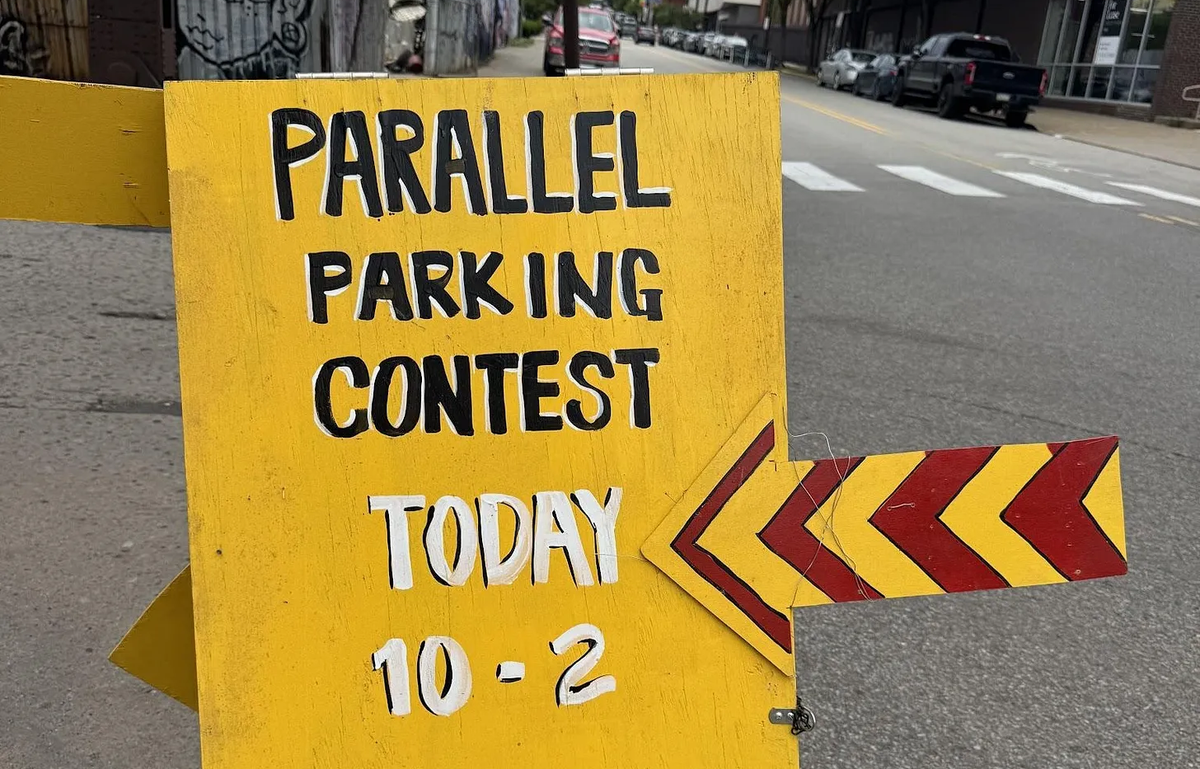
For six years, the Parallel Parking Championship in Pittsburgh, Pennsylvania has (for some of us) been motorsport’s crown jewel, a thrilling contest pitting man and machine against time and a 20 foot parking space. The event was first organized by a young couple named Dan and Jenna, just to settle a long-standing family debate about who was the best parallel parker. It has since grown into a raucous street party, a participatory art form, a gift to motorists, and a communal act of joy. Each driver begins from their preferred position and the timer starts when the referee sees the reverse lights of the car. The driver parks, then shouts “Done” out the window, stopping the clock. Hitting the curb or either adjacent car results in disqualification. Your final score is your time, multiplied by your distance to the curb. Ignore the units for now, and think about the implications. If one can get twice as close by taking twice as much time, that’s a decent tradeoff. There’s a small bonus for bigger vehicles, but it seemed insufficient; most good scores came from smaller cars. Our 16’ rental car was, comparatively, a boat. (via Why Is This Interesting)
In this New York cemetery every headstone or monument had to be made of metal
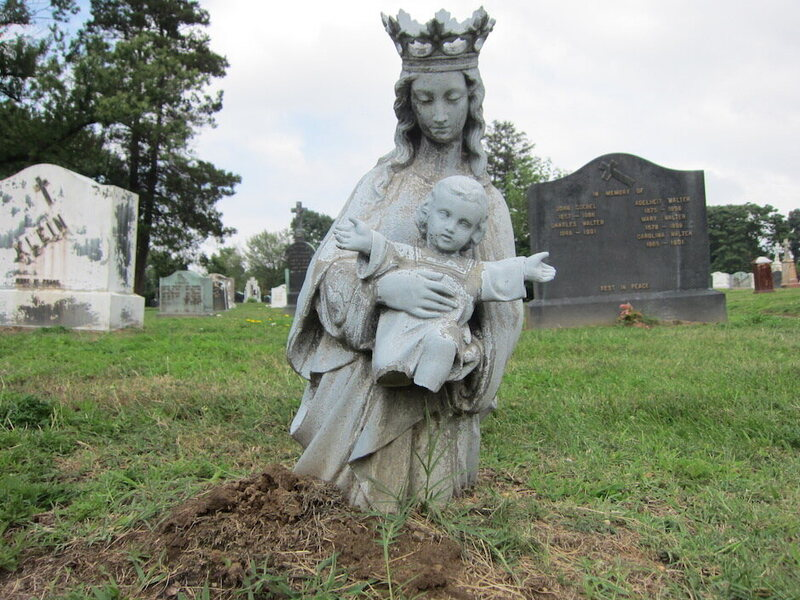
Glimpsed from the L train as it rumbles up to the open air at the Wilson Avenue station in Bushwick, Most Holy Trinity Cemetery isn’t immediately different from the other numerous burial grounds that cluster around the Brookyn-Queens border. Yet step inside its entrance and a rolling landscape of rust stretches before your eyes. All except the most recent graves are wood or metal, an early regulation set in place by the German Catholic Most Holy Trinity Church to enforce a posthumous equality. As the church’s website explains, “from the earliest days, stone monuments were not allowed because no distinctions were permitted to be made between the rich and the poor.” The New York City cemetery dates back to 1851, replacing an earlier church cemetery that adjoined Most Holy Trinity Church in Williamsburg. While the Bushwick neighborhood has shifted around it, its 23 acres still contain this history, worn as it may be. (via Atlas Obscura)
Some archaeologists are convinced a woman ruled as queen of Egypt 5,000 years ago
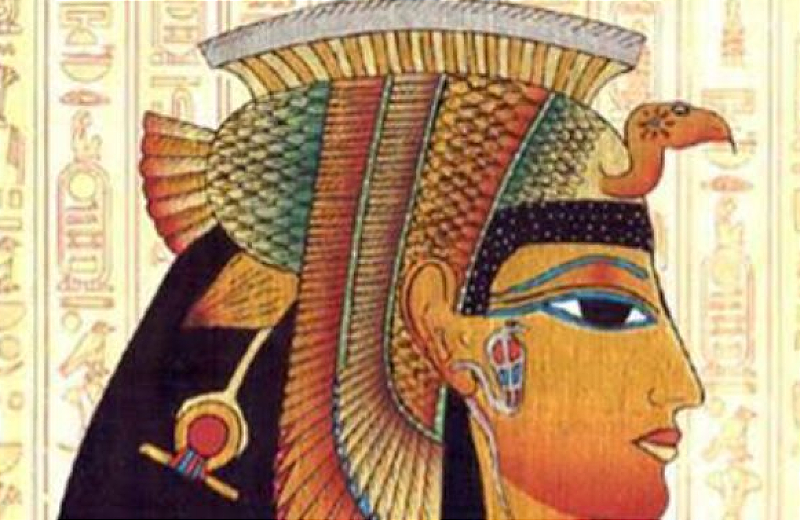
More than 5,000 years ago, a royal woman called Meretneith, lived in ancient Egypt. She was possibly the daughter of Djer, the third king of the First Dynasty, a period when the first kings ruled over a unified Egypt. Details over Meretneith’s exact royal status have remained murky. We know she ruled the country because her tomb complex was filled with riches fit for a male ruler of Egypt. At the very least, she was an interim ruler or co-regent. But did she ever rule Egypt in her own right? Egyptologists have long disputed whether Meretneith was an independent ruler of Egypt. Resolving that dispute would require finding a text that identifies her as a ruler. Our new research, published in the journal Prague Egyptological Studies, might do just that. Using a new digital technique, we examined hieroglyphs in the photo of a long-lost artefact, and the signs clearly point to Meretneith being one of the early rulers. (via Nautilus)
Hi everyone! Mathew Ingram here. I am able to continue writing this newsletter in part because of your financial help and support, which you can do either through my Patreon or by upgrading your subscription to a monthly contribution. I enjoy gathering all of these links and sharing them with you, but it does take time, and your support makes it possible for me to do that. I also write a weekly newsletter of technology analysis called The Torment Nexus.
An H.G. Wells story inspired a physicist to discover the nuclear chain reaction

The World Set Free is a novel written in 1913 by H. G. Wells. The book is based on a prediction of a more destructive and uncontrollable sort of weapon than the world has yet seen. Scientists of the time were well aware that the slow natural radioactive decay of elements like radium continues for thousands of years, and that while the rate of energy release is negligible, the total amount released is huge. Wells used this as the basis for his story. Leo Szilard, a Hungarian, grew up reading and enjoying the works of Wells and became a nuclear physicist. In 1929 he met Wells, who urged him to discover new sources of energy which could bring humankind to the stars and in 1932 he read and was disturbed by The World Set Free. Szilard saw a newspaper article in which Rutherford dismissed the idea that particle acceleration could ever generate energy. Szilard was irritated by Rutherford's arrogant rejection of the future of a yet undeveloped field, and a few days later the idea of nuclear chain reaction came to him. (via Wikipedia)
Leonardo da Vinci was the first to discover that blood played a role in erections
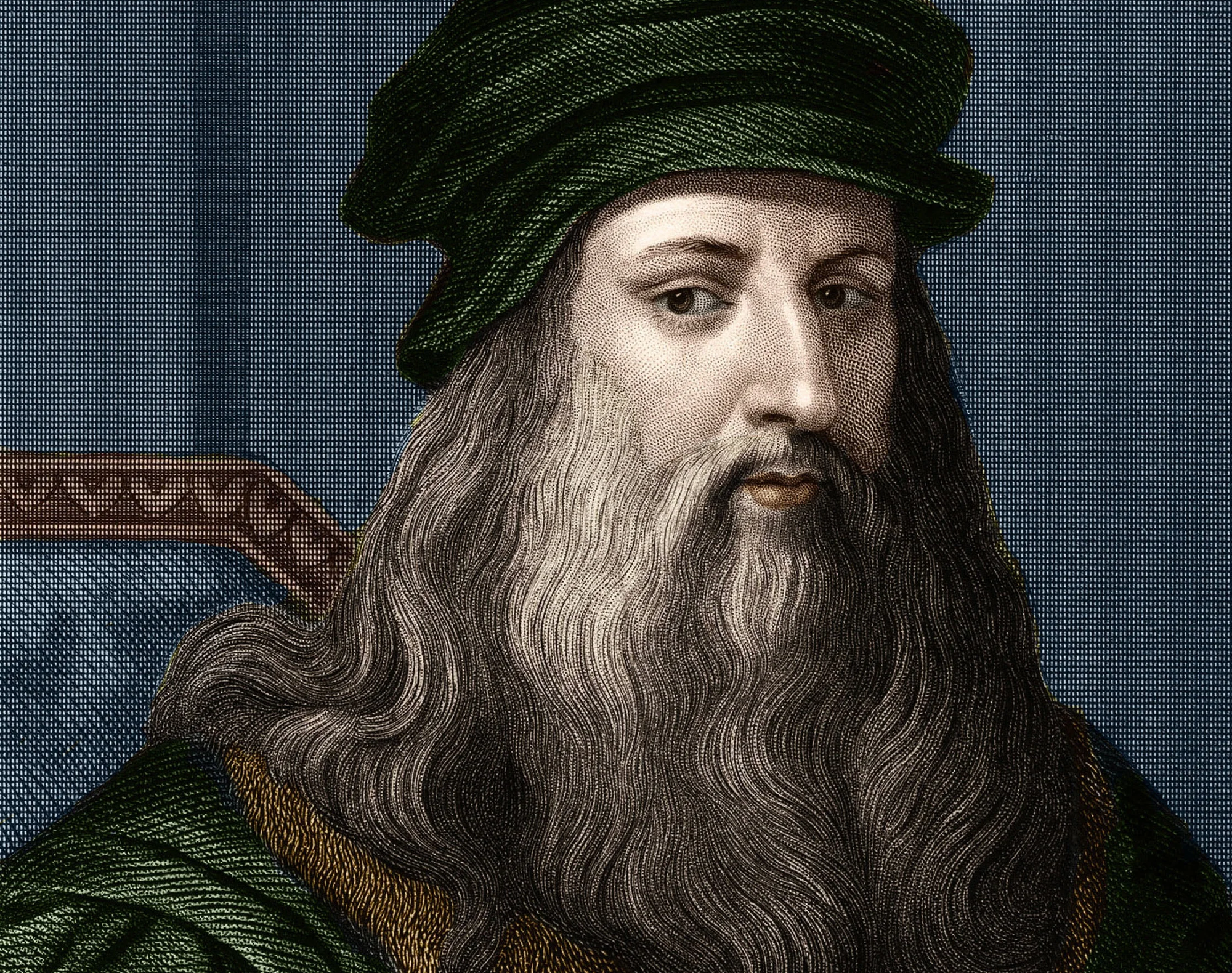
In Antiquity, Galen considered penile erection as the result the accumulation of air. His ideas so dominated medieval medicine that nearly everyone then alive was a Galenist. The beginning of the Renaissance shows meaningful examples of experimental scientific work on the penis. Leonardo Da Vinci correctly concluded that erections were caused by blood, and in the 18th century, Von Haller from Switzerland was the first who explained that erections were under the control of the nervous system. In the 19th century, a mindset that emphasized on experimentation determined a new direction, namely experimental physiology. Animal studies clarified that stimulation of the nervi erigentes‐induced small muscle relaxation in the corpora cavernosa. Nearly all were published in the German language and that may be one of the reasons that the existence of the concept of smooth muscle relaxation remained controversial until the first World Congress on Impotence in 1984 in Paris. (via National Library of Medicine)
Norwegian ad shows how Death and the Enshittificator team up to make things terrible

Acknowledgements: I find a lot of these links myself, but I also get some from other places that I rely on as "serendipity engines," such as The Morning News from Rosecrans Baldwin and Andrew Womack, Jodi Ettenberg's Curious About Everything, Dan Lewis's Now I Know, Robert Cottrell and Caroline Crampton's The Browser, Clive Thompson's Linkfest and Why Is This Interesting by Noah Brier and Colin Nagy. If you come across something you think should be included here, feel free to email me at mathew @ mathewingram dot com