He made small talk in Finland and was accused of being drunk


Hollywood actor Jason Segel spent an extended period of time in the Tampere region of Finland in late 2024, filming a movie. "I always try to be friendly. I say hello and ask how people are doing. However, that didn't work in Finland, where people are quite reserved," Segel told host Jimmy Kimmel in a recent interview. According to Segel, Finnish people walk with their heads down and avoid eye contact with other people. They were wary of Segel's friendliness. On one shopping trip, Segel was walking to his car and a female security guard followed him and asked him for his car keys. "She said I was clearly high because I had greeted people and was staring at the cereal shelf. I muttered that I wasn't high, I was just being friendly," Segel said. (via Helsinki Hanomat)
In the 1700s people would rather be beaten and robbed than give up their hats

Around 8pm on a cold February evening in 1733, a gentleman named Francis Peters was returning to his home near Knightsbridge, London, in a hackney cab, when someone knocked on the wooden shutters of the door. An armed horseman thrust a pistol inside, demanded Peters’s money and valuables and snatched a ring from his finger. Peters handed them over without fuss. But when the thief also snatched his hat and wig, he protested vigorously, though in vain – the robber rode away with his booty. The puzzle, to the modern reader, is that the hat was worth only five shillings – far less than the watch, ring and cash. Why make such a fuss? Historically, hats had a significance that went far beyond fashion and keeping the head warm. For any respectable man in Tudor, Stuart and Hanoverian England, to go hatless was almost unthinkable, while for people lower down the social scale, it suggested total destitution. (via The Conversation)
Rumours say the Denver airport has secret tunnels for aliens and a statue that kills people

The bizarre stories started long before the first flight took off in 1995. Denver already had Stapleton International Airport, just ten miles from downtown. So when officials announced plans to build an even larger airport, residents were baffled. When Denver International Airport finally opened, six years after breaking ground in 1989, it was twice the size of Manhattan and $2 million over budget. The sprawling complex continues to be shrouded in secrecy and a magnet for conspiracy theories. Even before stepping inside, the airport’s most infamous resident greets you from the side of Peña Boulevard – a 32-foot-tall cobalt blue mustang with glowing red eyes. Locals call the fiberglass beast Blucifer. In 2006, a piece of the sculpture fell on 65-year-old artist Luis Jiménez during construction, severing an artery and killing him. (via The Independent)
Hi everyone! Mathew Ingram here. I am able to continue writing this newsletter in part because of your financial help and support, which you can do either through my Patreon or by upgrading your subscription to a monthly contribution. I enjoy gathering all of these links and sharing them with you, but it does take time, and your support makes it possible for me to do that. I also write a weekly newsletter of technology analysis called The Torment Nexus.
A new metal challenges conventional physics by conducting three times better than copper

Copper moves the world’s heat. For more than a century it has been recognized as one of the best heat conductors in nature, and this property made copper the go-to choice to cool electronics, industrial equipment, data centers and power systems. But there’s a new, record-breakingly cool metal in town. A metallic material called θ-phase tantalum nitride achieved a thermal conductivity of about 1,110 watts per meter-kelvin — about three times higher than copper’s 400 watts per meter-kelvin. And it works in a way scientists have never seen before. Similar to the way pure carbon can form diamonds, graphene, or other structures, tantalum nitride exists in multiple forms with very different properties. Scientists have known about some of those forms for decades, but until now no one had studied the specific configuration Hu and his colleagues focused on, in which the material’s atoms are arranged in a continuous, highly ordered crystal lattice. (via Scientific American)
Skoda has invented a bicycle bell that can penetrate noise-cancelling headphones
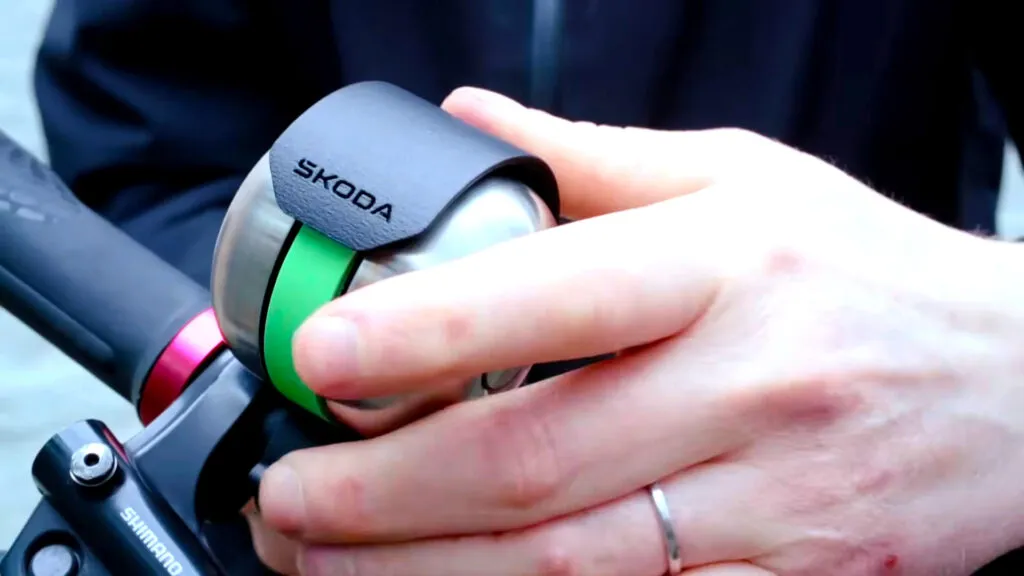
Riding a bike anywhere that pedestrians travel can be a bit sketchy in today’s modern world. It’s hard to go anywhere without seeing walkers, joggers, and runners blissfully enjoying noise-cancelling headphones these days. Now imagine trying to alert such a pedestrian to your presence, only for them not to hear anything. Skoda says it’s fixed the issue with something it’s calling the DuoBell. The Czech automaker developed a prototype bell with researchers and audiologists from the University of Salford after looking into how modern ANC headphones affect a pedestrian’s ability to hear cyclists. Instead of simply making the bell louder, the team got clever. Researchers found a narrow “safety gap” in ANC systems between 750 and 780 Hz. DuoBell emits sound in that range, then adds a second resonator and a hammer that strikes in an irregular pattern. The result is a sound that ANC algorithms struggle to recognize. (via Car Scoops)
This autistic man's big wish was to meet actor Jack Black

Acknowledgements: I find a lot of these links myself, but I also get some from other places that I rely on as "serendipity engines," such as The Morning News from Rosecrans Baldwin and Andrew Womack, Jodi Ettenberg's Curious About Everything, Dan Lewis's Now I Know, Robert Cottrell and Caroline Crampton's The Browser, Clive Thompson's Linkfest and Why Is This Interesting by Noah Brier and Colin Nagy. If you come across something you think should be included here, feel free to email me at mathew @ mathewingram dot com