A quadriplegic makes music with his brain implant


Galen Buckwalter didn’t hesitate to get a craniotomy in 2024 as part of a brain implant study at Caltech. The 69-year-old research psychologist wanted to contribute to cutting-edge science that could help other people with paralysis. Buckwalter has been a quadriplegic since a diving accident at age 16 left him paralyzed from the chest down. The six chips in his brain, made by Blackrock Neurotech, read activity from his neurons and decode movement intention. They enable him to operate a computer with his thoughts, feel sensation in his fingers that he had lost, and, more recently, make music with his mind. Known as a brain-computer interface, or BCI, the technology is being developed to restore communication and movement in people with severe motor disabilities. But Buckwalter’s experience shows that the technology can be used in ways that are not purely functional, such as an outlet for creative expression. (via Wired)
Huge quantities of German ammunition lie at the bottom of Norwegian lakes

The stockpile of German ammunition left in Norway in 1945 could have been cleared and dismantled by the Germans. Norway declined the offer and began dumping it in Lake Mjøsa and other lakes instead. At the end of the Second World War, the German armed forces had large quantities of ammunition in Norway. It was stored in various units and large warehouses. In addition, there were explosives belonging to the police and Organisation Todt — a German semi-military organization involved in construction and engineering. There were also components and ammunition stored at the ammunition factory Raufoss ammunisjonsfabrikker. At the end of the war, the German army and coastal artillery troops had 90,000 tonnes of ammunition stored in Norway, not including munitions from the other branches such as the navy. (via Phys.org)
He bought a domain name on a whim and wound up building an online onion-selling business

Oddly enough, it didn't start with an idea. Back in 2014, the domain name VidaliaOnions.com expired, and went up for auction. For some reason the original owner abandoned it, and being a Georgia native, I recognized it ’cause I was familiar with the industry. I’ve been buying expired or abandoned domain names for a while, and enjoy developing them into niche businesses. This one was different though – I backordered the domain as a spectator, but for kicks & giggles, I dropped in a bid around $2,200 ’cause I was confident I’d be outbid. 5 minutes later, I was the proud owner of VidaliaOnions.com. I had no idea what to do with it. After the domain landed in my account, I attempted to re-focus my attention on other projects, but the name kept clawing at me. An interesting idea, but daunting to approach. I’m not a farmer, I don’t have employees, I don’t have a packing shed. And I have no distribution system setup. (via Deep South Ventures)
Hi everyone! Mathew Ingram here. I am able to continue writing this newsletter in part because of your financial help and support, which you can do either through my Patreon or by upgrading your subscription to a monthly contribution. I enjoy gathering all of these links and sharing them with you, but it does take time, and your support makes it possible for me to do that. I also write a weekly newsletter of technology analysis called The Torment Nexus.
Japan has more than nine million abandoned or vacant homes due to a shrinking population

The number of vacant houses in Japan has surged to a record high of nine million – more than enough for each person in New York City – as the east Asian country continues to struggle with its ever-declining population. Abandoned houses are known in Japan as “akiya” – a term that usually refers to derelict residential homes tucked away in rural areas. But more akiya are being seen in major cities, such as Tokyo and Kyoto, and that’s a problem for a government that’s already grappling with an aging population and an alarming fall in the number of children born each year. According to figures compiled by the Ministry of Internal Affairs and Communications, 14% of all residential properties in Japan are vacant. The growing number presents a range of other problems for the government and communities, experts told CNN. (via CNN)
The enduring mystery of Moldy Mary and the discovery of a more powerful breed of penicillin

Penicillium rubens strain NRRL 1951 is best known as the bluish-green mold that helped scientists develop methods to mass-produce the powerful antibiotic penicillin during the closing years of World War II. Ironically, the mold strain that stood out among them all came not from the soils of a distant locale, but rather atop a cantaloupe found at a Peoria market. Who actually found the cantaloupe — and was nicknamed “Moldy Mary” by some — is uncertain. The best-known account centers around Mary Kay Hunt, who studied bacteriology and public health while in college and was a laboratory technician. Hunt offered specific details about her efforts, including cutting up the cantaloupe she found. However a 1976 news article gave a different account, crediting a Peoria woman, who handed the cantaloupe to a guard and left without identifying herself. (via the USDA)
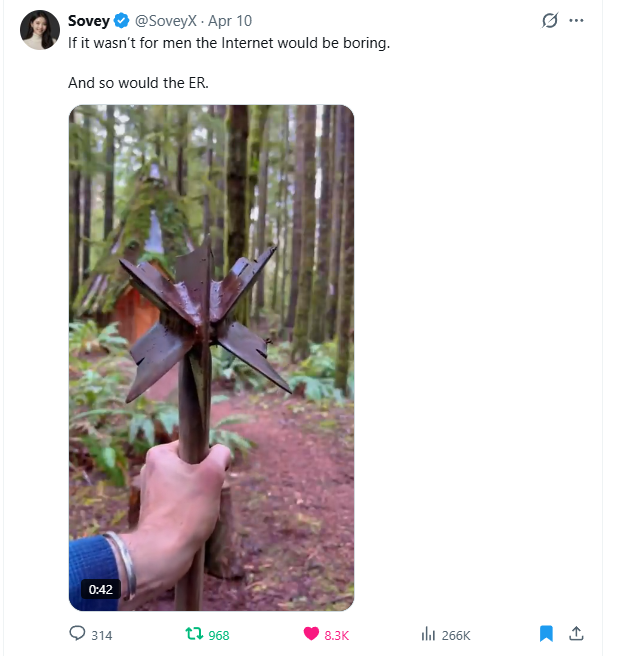
When chopping wood the old-fashioned way is too boring
Acknowledgements: I find a lot of these links myself, but I also get some from other places that I rely on as "serendipity engines," such as The Morning News from Rosecrans Baldwin and Andrew Womack, Jodi Ettenberg's Curious About Everything, Dan Lewis's Now I Know, Robert Cottrell and Caroline Crampton's The Browser, Clive Thompson's Linkfest and Why Is This Interesting by Noah Brier and Colin Nagy. If you come across something you think should be included here, feel free to email me at mathew @ mathewingram dot com