A flood of beer sounds great but one in London in 1814 was not


The Horse Shoe Brewery stood at the corner of Great Russell Street and Tottenham Court Road. In 1810 the brewery, Meux and Company, had had a 22 foot high wooden fermentation tank installed on the premises. Held together with massive iron rings, this huge vat held the equivalent of over 3,500 barrels of brown porter ale, a beer not unlike stout. On the afternoon of October 17th 1814 one of the iron rings around the tank snapped. About an hour later the whole tank ruptured, releasing the hot fermenting ale with such force that the back wall of the brewery collapsed. The force also blasted open several more vats, adding their contents to the flood which now burst forth onto the street. More than 320,000 gallons of beer were released into the area. The 15 foot high wave of beer and debris inundated the basements of two houses, causing them to collapse. In all, eight people were killed. Three brewery workers were rescued from the waist-high flood and another was pulled alive from the rubble. (via Historic UK)
The Australian bush coconut can be eaten but it is definitely not like a real coconut
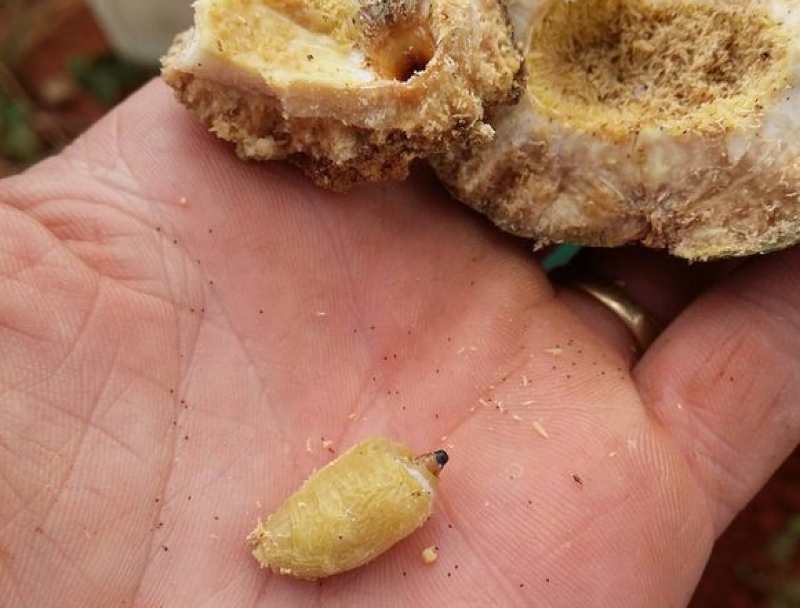
The origins of bush coconuts are a little gruesome. A grublike coccid insect, usually Cystococcus pomiformis, settles on the branch of a desert bloodwood tree. She —and it’s always a she —irritates the tree until it defends itself by sprouting a knobby tumor. This gall grows around the grub, who spends the rest of her life there, drinking tree sap and even mating with male grubs (via a tiny air hole) from inside her fortress. Together, the gall and the worm form the bush coconut, sometimes called the less appetizing “bloodwood gall.” Lumpy and small, it doesn’t look much like a coconut. The name instead comes from the gall’s coconut-flavored flesh. Foragers typically also eat the worm, which has a sweet, juicy taste. Falling into the category of native food sources known as “bush tucker,” the bush coconut has long been a source of nutrition for aboriginal Australians in the northern savanna woodlands. (via Atlas Obscura)
Frederick The Great of Prussia invented the concept of no-fault divorce in 1757

In early modern Europe, Prussia took a pioneering role with Frederick the Great's 1757 edict allowing marriages to be dissolved on the ground of serious and continuous hostility between spouses, without pointing to any one guilty party. This early example of no-fault divorce was expanded on and formalized with the 1794 General State Laws for the Prussian States, which allowed childless couples to file for divorce without giving a ground. The first modern no-fault divorce law was enacted in Russia in December 1917 following the October Revolution of the same year. Regarding marriage as a bourgeois institution, the new government transferred divorce jurisdiction from the Russian Orthodox Church to the state courts, which could grant it on application of either spouse. Alimony guarantees were weak until a new family code was passed in 1926. In 1969, California became the first U.S. state to permit no-fault divorce. (via Wikipedia)
Hi everyone! Mathew Ingram here. I am able to continue writing this newsletter in part because of your financial help and support, which you can do either through my Patreon or by upgrading your subscription to a monthly contribution. I enjoy gathering all of these links and sharing them with you, but it does take time, and your support makes it possible for me to do that. I also write a weekly newsletter of technology analysis called The Torment Nexus.
We have Jim Moylan to thank for the little arrow that shows you which side the gas tank is on
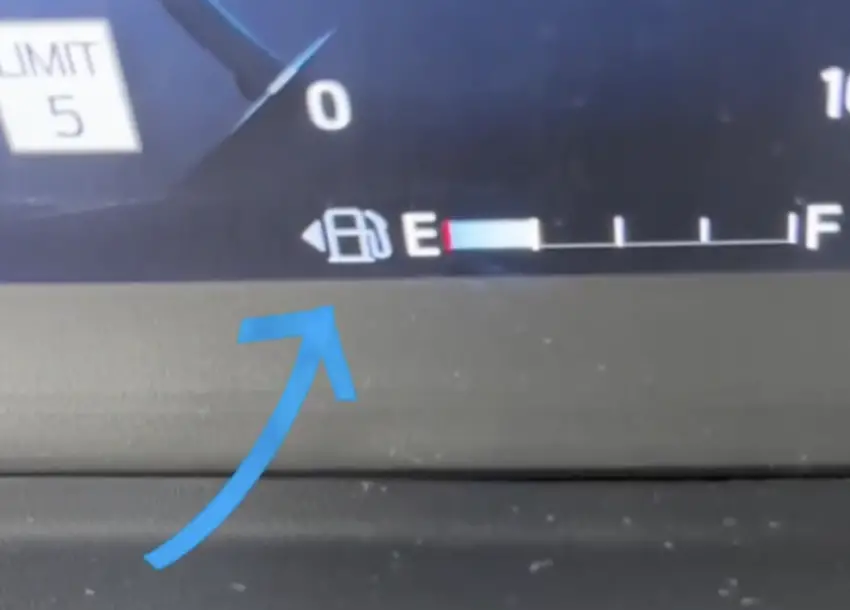
Modern vehicles are packed with features that make driving more convenient, but some innovations are so seamlessly integrated into our experience that we rarely think about their origins. One such feature is the small gas tank indicator arrow — also known as the Moylan Arrow — that points to the side of the vehicle where the gas tank filler is located. While many drivers have benefitted from this simple yet practical invention, few know it was the brainchild of a Ford engineer. Jim Moylan was frustrated by the lack of a clear way to determine which side of the car the gas tank was on. Moylan sketched a small arrow on the fuel gauge and submitted the idea to Ford’s internal suggestion system, asking, “Wouldn’t it be great if you always knew what side of the car the gas tank was on?” Ford executives wasted no time incorporating it into their production vehicles and it proved so practical that other automakers followed suit. (via Key West Ford)
The two meanings of the term shark evolved from two completely different words

The English word "shark" was two different meanings: a predatory cartilaginous fish and a predatory scoundrel. We sometimes understand the scoundrel to be by metaphor from the fish, but evidence suggests these two meanings have entirely separate origins. The scoundrel is borrowed from German "schurke" meaning villain, also borrowed in Dutch as "schurk." This is traced to Middle German verb "schurgen" meaning to push or incite, and is very similar to modern German "schüren" meaning to stoke or to stir up. Now, there is one use of "shark" to refer to fish in Middle English, in 1442, in the Letters of Thomas Bekynton, Secretary to Henry VI. It's pretty unclear what's going on here. Why exactly does Bekynton switch to apparent French grammar but a not-at-all French looking word "le Shark" in the middle of this Latin letter? There is no further use of "shark" in reference to a fish for 127 years. (via Word Family Friday)
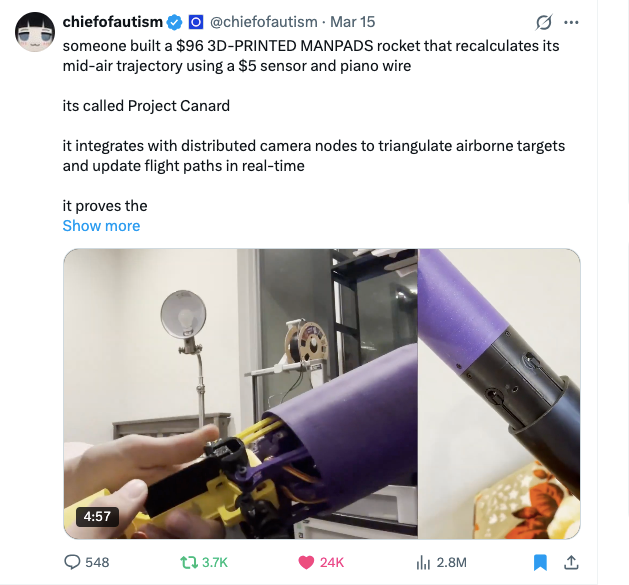
He built a 3D-printed shoulder-mounted autonomous rocket for $96
Acknowledgements: I find a lot of these links myself, but I also get some from other places that I rely on as "serendipity engines," such as The Morning News from Rosecrans Baldwin and Andrew Womack, Jodi Ettenberg's Curious About Everything, Dan Lewis's Now I Know, Robert Cottrell and Caroline Crampton's The Browser, Clive Thompson's Linkfest and Why Is This Interesting by Noah Brier and Colin Nagy. If you come across something you think should be included here, feel free to email me at mathew @ mathewingram dot com