He invented an early gas mask and a prototype traffic light


A prolific inventor who called himself the “Black Edison,” Garrett Morgan created early versions of the traffic light and gas mask. He began his career as a sewing-machine mechanic before patenting an improved sewing machine design and a hair-straightening product, among other inventions. His breathing device, known as a safety hood, later provided the blueprint for World War I gas masks. In 1923, Morgan invented a safer traffic light. Born in Paris, Kentucky, on March 4, 1877, Garrett Augustus Morgan was the seventh of 11 children. His mother, Elizabeth Reed, was of Indian and African descent and the daughter of a Baptist minister. His father, Sydney, a formerly enslaved man freed in 1863, was the son of a Confederate colonel. One of Morgan’s first inventions involved the sewing machine. After learning the inner workings of the machines and how to fix them at his factory jobs, Morgan obtained a patent for an improved sewing machine and opened his own repair business. (via Biography.com)
In the 1960s the US set off a nuclear explosion in space as part of a project called Starfish Prime
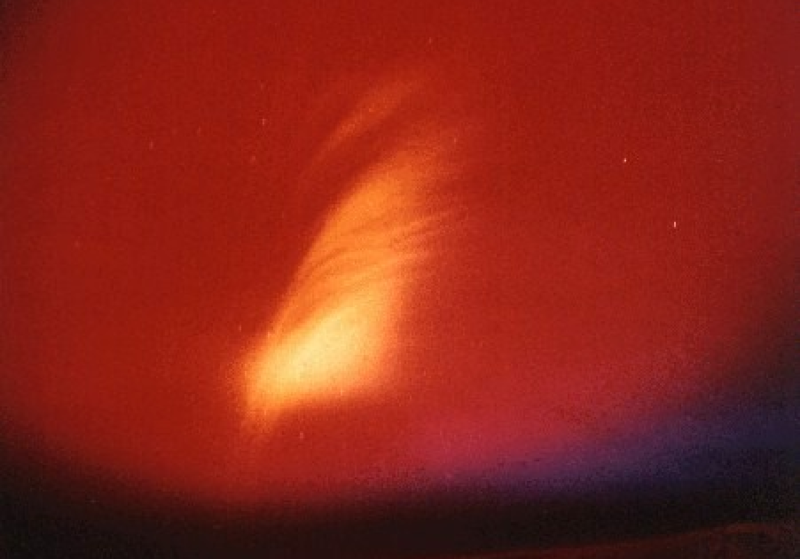
Starfish Prime was a high-altitude nuclear test conducted by the United States, a joint effort of the Atomic Energy Commission (AEC) and the Defense Atomic Support Agency. It was launched from Johnston Atoll on July 9, 1962, and was the largest nuclear test conducted in outer space, and one of five conducted by the US in space. A Thor rocket carrying a W49 thermonuclear warhead (designed at Los Alamos Scientific Laboratory) and a Mk. 2 reentry vehicle was launched from Johnston Atoll in the Pacific Ocean, about 900 miles (1,450 km) west-southwest of Hawaii. The explosion took place at an altitude of 250 miles (400 km), above a point 19 miles (31 km) southwest of Johnston Atoll. It had a yield of 1.4 Mt. The Starfish test was one of five high-altitude tests grouped together as Operation Fishbowl within the larger Operation Dominic, a series of tests in 1962 begun in response to the Soviet announcement that they would end a three-year moratorium on testing. (via Wikipedia)
This doctor could tell what song was on a record by just looking at the grooves

Dr. Arthur Lintgen had an unusual talent. By looking at the grooves on a vinyl record, he could identify what the recording was. Within limits. It had to be classical music (no rock 'n' roll), preferably from the time of Beethoven up to the present. And it had to be a complete recording. Not an excerpt. But within those parameters, he was pretty much flawless. The Haydn Symphony, No. 100 is outside Lintgen's prescribed ground rules (too early), but we asked him to look at it anyway. The process was illuminating. The four bands on the record surface suggested to him the four movements of the classical symphony. This was reinforced by the patterns on band three which indicated to him the A-B-A minuet form of this genre. Grooves reveal to Lintgen nothing about pitch, but they do seem to tell him a great deal about volume, timbre, and movements. "Haydn," he determined finally. "I don't know which one." (via Weird Universe)
Hi everyone! Mathew Ingram here. I am able to continue writing this newsletter in part because of your financial help and support, which you can do either through my Patreon or by upgrading your subscription to a monthly contribution. I enjoy gathering all of these links and sharing them with you, but it does take time, and your support makes it possible for me to do that. I also write a weekly newsletter of technology analysis called The Torment Nexus.
A Venezuelan highway is plagued by a strange goo that has been blamed for 1,800 deaths

In 1986, road crews repairing 30-year-old pavement on the route between Caracas and its airport spotted a 50-yard smudge of greasy black gunk. It looked like chewed bubble gum, made the road slick as ice, and swelled in hot, wet weather, then shrank when things turned cold and dry. By 1992, the goo — locals call it La Mancha Negra, the Black Stain — had been blamed for around 1,800 deaths on that airport road. Nobody has figured out what it is. President Carlos Andrés Pérez brought in specialists from the U.S. in 1991. The Venezuelan Ministry of Transport eventually called the stuff a slurry of dust, oil, organic gunk, and synthetic compounds. Another analysis called it used engine oil cut with corrosive brake fluid. The leading guess blames thousands of leaky old cars dripping fluids that bond with the asphalt in the heat. Other theories floated raw sewage from hillside slums and bad asphalt sweating oil. (via Boing Boing)
His brain injury turned this ex-con into both a poet and a painter

Ten days after having a subarachnoid haemorrhage – a stroke caused by bleeding in and around the brain – Tommy McHugh, an ex-con who’d been in his fair share of scraps, became a new man, with a personality that nobody recognised. When he was a young man, Tommy did time in prison. But after his stroke at age 51, everything changed. “I could taste the femininity inside of myself,” he said. “My head was full of rhymes and images and pictures.” Not only did he feel a sudden urge to write poetry, but he also began to paint and draw obsessively for up to 19 hours a day. He was never artistic before – in fact, he joked that he’d never even been in an art gallery “except to maybe steal something”. Desperate to find out what was going on, Tommy wrote to several neuroscientists and end up working closely with Alice Flaherty at Harvard Medical School and Mark Lythgoe at University College London. (via New Scientist)
He knew if someone asked for a volunteer his girlfriend would put up her hand

Acknowledgements: I find a lot of these links myself, but I also get some from other places that I rely on as "serendipity engines," such as The Morning News from Rosecrans Baldwin and Andrew Womack, Jodi Ettenberg's Curious About Everything, Dan Lewis's Now I Know, Robert Cottrell and Caroline Crampton's The Browser, Clive Thompson's Linkfest and Why Is This Interesting by Noah Brier and Colin Nagy. If you come across something you think should be included here, feel free to email me at mathew @ mathewingram dot com