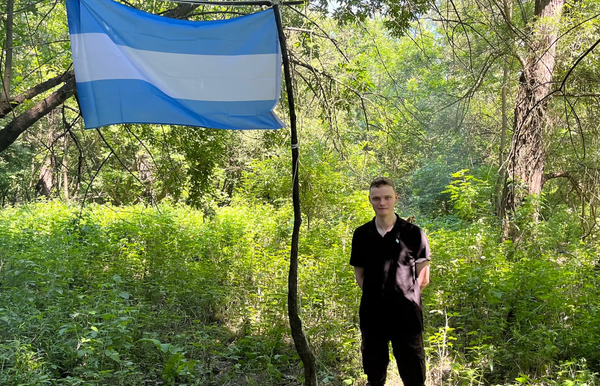
Pizza-parlor owner got shot and invented the bulletproof vest


Wearing a green hat, spectacles and ear protectors, a man loads .44 Magnum bullets into the chamber of a gun. He hands his car keys to another man and twirls the gun cylinder while invoking Matt Dillon, the fictional marshal of Dodge City in Gunsmoke. He proceeds to turn the gun on himself and, after a tense pause relieved only by birdsong, fires into his chest. The bullet had been stopped by body armour. Davis was the inventor of the modern-day bulletproof vest and shot himself point blank 192 times to prove that it worked. The ex-Marine, bankrupt pizzeria owner and born showman also mythologised his work by producing his own low-budget movies popular with police across America. At its zenith Davis’s company, Second Chance, was worth more than $50m with products being worn by police, soldiers and even the president. (via The Guardian)
An amateur cryptographer claims he has solved the Black Dahlia and Zodiac killer cases
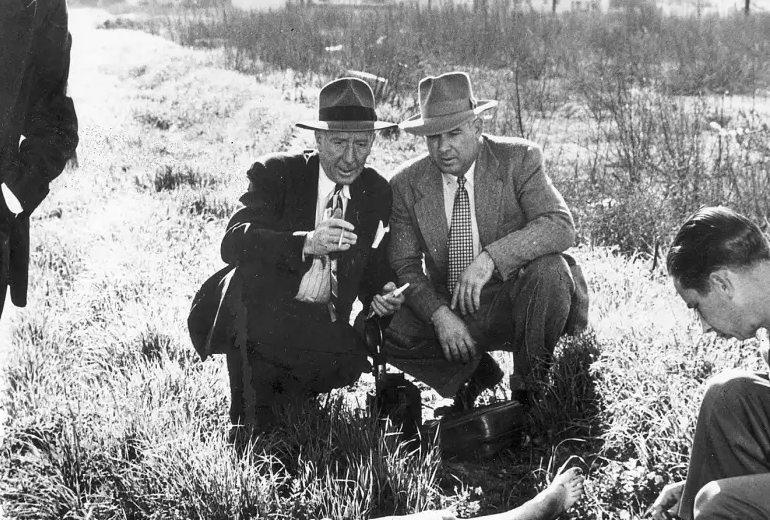
When police questioned Marvin Margolis following the murder of Elizabeth Short, also known as the Black Dahlia, he lied about how well he had known her. The 22-year-old Short had been found mutilated in a weedy lot in South Los Angeles, cut in half with what detectives thought was surgical skill. A generation later and hundreds of miles north, a killer who called himself the Zodiac terrorized the San Francisco Bay Area with five seemingly random murders from 1968 to 1969, taunting police and media for years with letters and cryptograms. A letter he sent in April 1970 to the San Francisco Chronicle said “My name is —” followed by a 13-character string of letters and symbols. It came to be called the Z13 cipher, and its brevity has stymied generations of PhDs. Alex Baber, a 50-year-old West Virginia man who dropped out of high school and taught himself codebreaking, now says he has cracked the Zodiac killer’s identity. (via the LA Times)
The Colombian Army released a song with a message in Morse code for hostages

During a Colombian civil war, many civilians and soldiers had been abducted by a guerilla group FARC. Colombian Colonel Jose Espejo needed to get the message to a group of soldiers who were being held hostage deep in the jungle that they would be rescued soon. So he had his friend, advertising executive Juan Carlos Ortiz, produce a pop song with a secret coded message that help was coming. They produced a song "Mejores Dias" (Better Days), by Natalia Gutierrez y Angelo, with a Morse code signal hidden within it: "19 people rescued. You're next. Don't lose hope." The song was played on over 300 radio stations throughout rural Colombia and heard by over 3 million people. Even members of the FARC reportedly found it enjoyable, oblivious to its secret purpose. (via Boing Boing)
Hi everyone! Mathew Ingram here. I am able to continue writing this newsletter in part because of your financial help and support, which you can do either through my Patreon or by upgrading your subscription to a monthly contribution. I enjoy gathering all of these links and sharing them with you, but it does take time, and your support makes it possible for me to do that. I also write a weekly newsletter of technology analysis called The Torment Nexus.
A priceless medieval book by this hermit and mystic was found in a school library
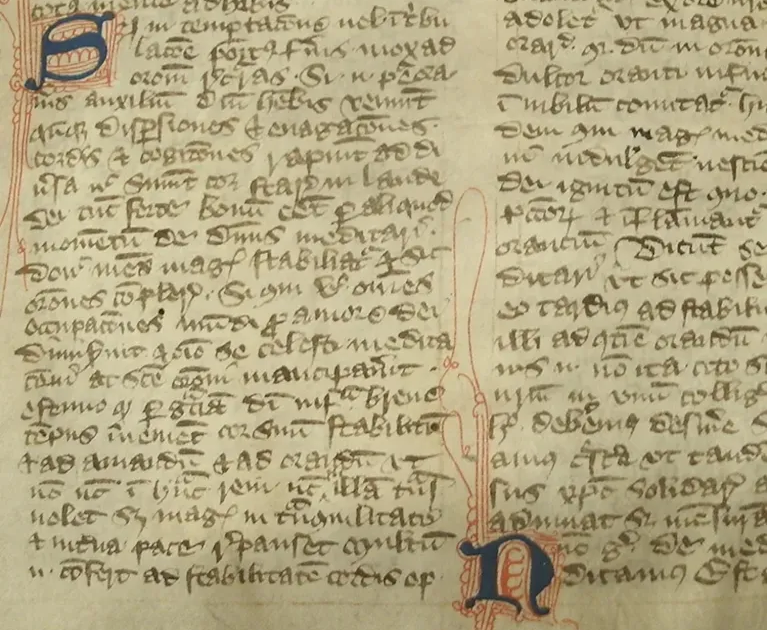
For generations, a misidentified medieval manuscript was hidden in a 474-year-old English boarding school’s library. After a careful new analysis, a medieval literature researcher confirmed the manuscript is actually the oldest and only known edition of Richard Rolle’s The Emending of Life written in its original Latin. Most people today may not be familiar with Richard Rolle, but he was the Late Medieval Era’s most widely read author. One of a handful of writers known as the Middle English Mystics, Rolle was born sometime around 1300 CE in Yorkshire, England, and spent the majority of his adult life as a hermit until his death in 1349, possibly due to the Black Death. Scholars first formally described MS 25 during the 1920s, but the work had actually resided in Shrewsbury since its donation to the library in 1607. (via Popular Science)
Deer may leave light patterns for other deer by scraping away the bark of trees

At dawn and dusk, forests often appear muted and nearly monochromatic to human eyes. But white-tailed deer might see a very different landscape: to them, the forest could be aglow.Since the 1970s, biologists have understood that deer leave signposts — spots where they have rubbed their antlers on trees — for scent-based communication. But one group of researchers wondered whether these marks also provide visual messages.The researchers scanned and analyzed 146 such signposts in Whitehall Forest in the state of Georgia using ultraviolet lights. They found that although the signposts look unremarkable in daytime lighting, they reemit blue-green light that deer can see when exposed to ultraviolet wavelengths common at dawn and dusk. This might happen because antler rubs strip bark away, revealing lignin-rich inner wood that reemits the longer wavelengths in a way bark does not. (via Scientific American)
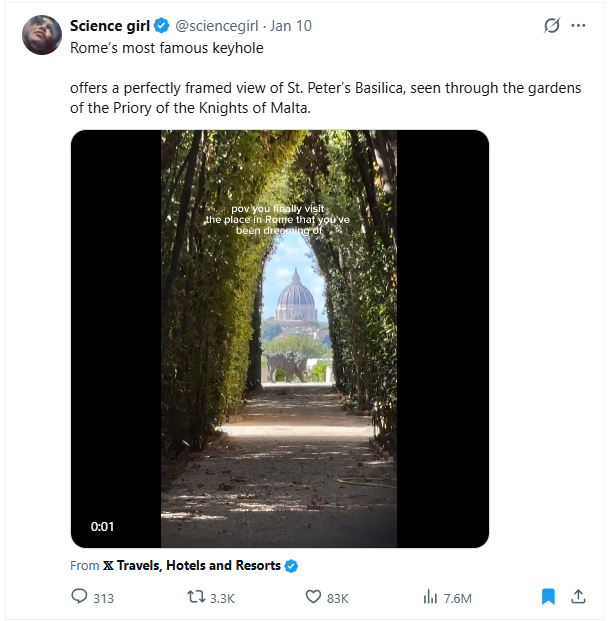
Rome's most famous keyhole frames St. Peter's Basilica through the gardens of Malta
Acknowledgements: I find a lot of these links myself, but I also get some from other places that I rely on as "serendipity engines," such as The Morning News from Rosecrans Baldwin and Andrew Womack, Jodi Ettenberg's Curious About Everything, Dan Lewis's Now I Know, Robert Cottrell and Caroline Crampton's The Browser, Clive Thompson's Linkfest and Why Is This Interesting by Noah Brier and Colin Nagy. If you come across something you think should be included here, feel free to email me at mathew @ mathewingram dot com