NY home contains a hidden door to the Underground Railroad


Hidden inside a historic 19th century house on East Fourth Street in Manhattan is a secret sanctuary. Ever since the Merchant’s House Museum opened its doors to the public in 1936, visitors have lined up to get a taste of “old New York.” The Treadwell family lived there from 1835 until 1933. Their residence is frozen in time, from a ruby-red front parlor complete with its original piano to the kitchen with its cast-iron coal-burning stove. But when visitors head upstairs to the bedrooms on the second floor, there’s something strategically hidden within the walls of Manhattan’s first landmarked building: a link to the Underground Railroad. When you remove the heavy bottom drawer in a chest of drawers, you can see a rectangular opening cut into the floorboards, which leads to an enclosed space and a ladder that leads down to the ground floor. (via NY1)
No one knows who wrote the massive hand-illustrated book known as the Devil's Bible
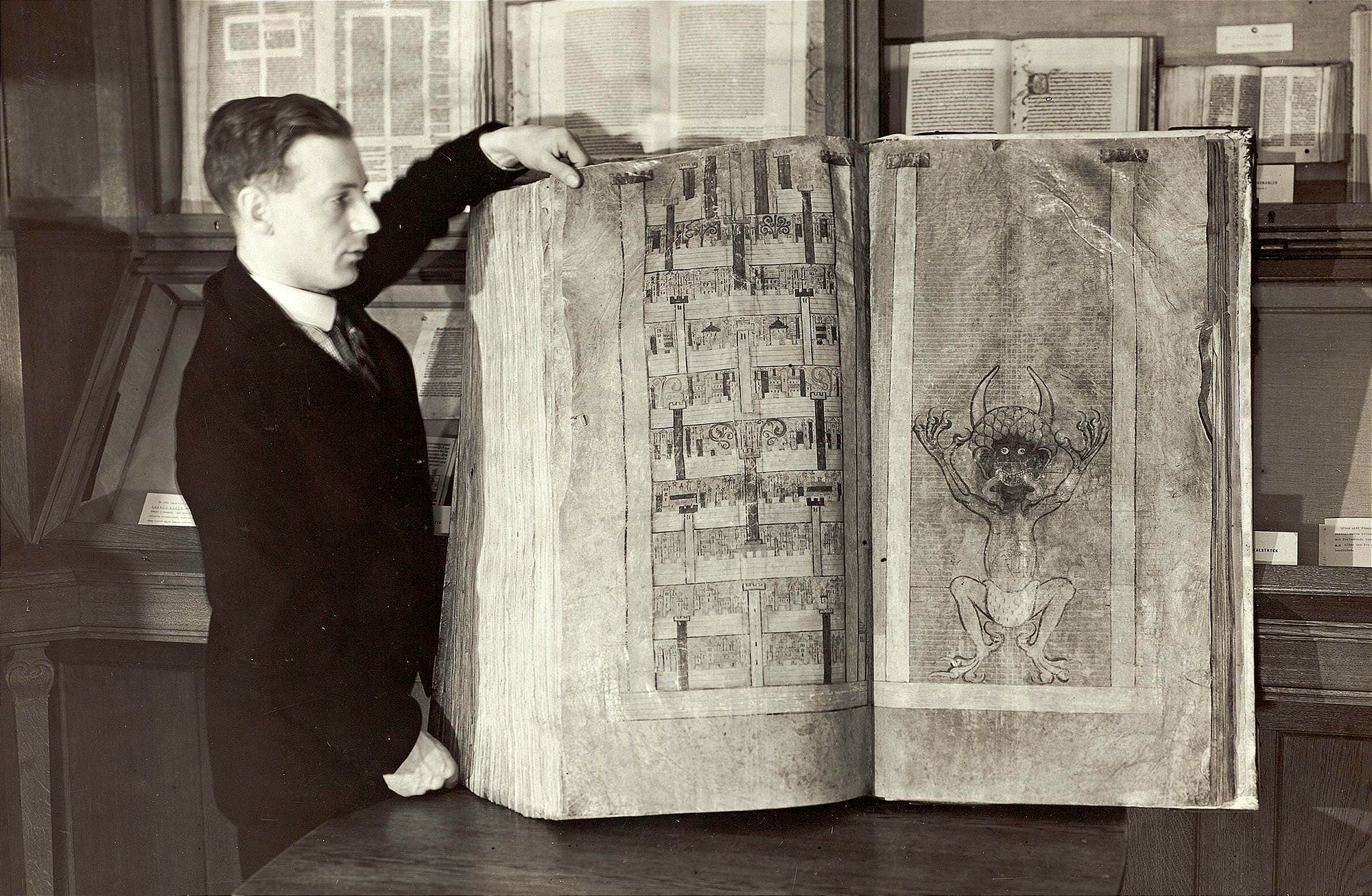
The Codex Gigas, also known as the Devil’s Bible, is famous for two reasons: it is believed to be the world’s largest preserved medieval manuscript, at over three feet tall and weighing over 160 pounds (Codex Gigas means "giant book") and it also contains a large, full-page portrait of the Devil. The Codex Gigas was originally created for a Bohemian monastery, but was brought to Sweden as spoils of war in the 17th century. Among other things, the manuscript contains a complete Bible, historical texts, magic formulas and spells. A work of this kind would have typically been the work of several scribes whose contributions would be obvious through differences in their handwriting. Not so for the Codex Gigas, whose 620 pages show exactly one handwriting style. For a single person to complete a such a large book would have taken over 20 years. (via the NLS)
An ancient Roman rock with carved lines may have been an early board game
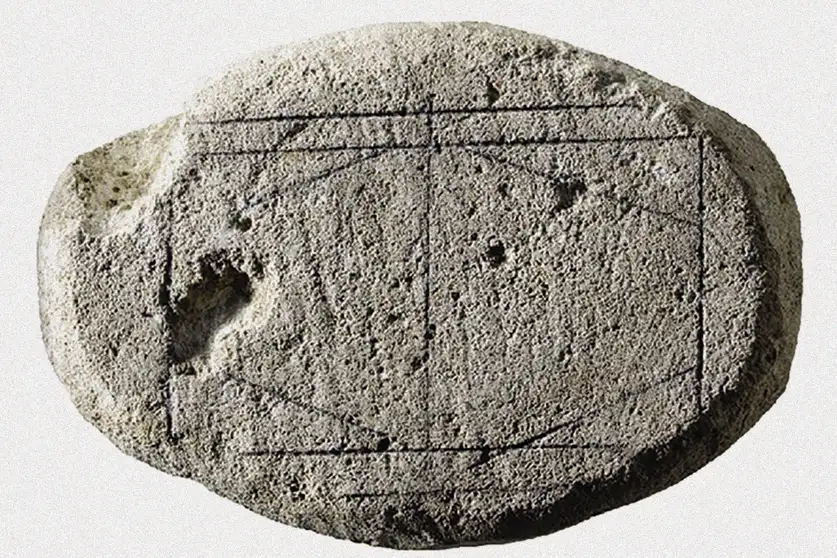
A mysterious flat stone with a geometric pattern of straight lines carved into it may be a previously unknown Roman board game.Thousands of simulations by artificial intelligence of how sliding stone or glass pieces could have marked the surface suggest it was an early example of a blocking game, a type not documented in Europe until several centuries later in the Middle Ages. In the Roman Museum in Heerlen, the Netherlands, Walter Crist at Leiden University, also in the Netherlands, came across a flat stone measuring 212 by 145 millimetres with a geometric pattern carved on its upper face. It was found at the Roman town of Coriovallum, which is buried under present-day Heerlen, and the type of limestone it is made of was often imported from France for use in decorative elements on buildings between AD 250 and 476. (via New Scientist)
Hi everyone! Mathew Ingram here. I am able to continue writing this newsletter in part because of your financial help and support, which you can do either through my Patreon or by upgrading your subscription to a monthly contribution. I enjoy gathering all of these links and sharing them with you, but it does take time, and your support makes it possible for me to do that. I also write a weekly newsletter of technology analysis called The Torment Nexus.
In the 1950s the Army had a helicopter square-dancing team with helicopters in costumes

In the 1950s, the U.S. Army conceived of a way to promote helicopters at national air shows across America - by square dancing with helicopters. A team of expert pilots was assembled to perform these incredible dancing stunts. "Boy" helicopters were dressed in straw hats and corn-cob pipes and "Girl" helicopters were dressed in skirts and long hair made from mops. They danced to classics such as "Turkey in the Straw" and "The Arkansas Traveler". The team also had a series of helicopter "clowns" decorated with goofy smiles and big red noses. The square-dancing team's flagship performance at the 1956 National Air Show in Oklahoma wowed spectators as they danced their way into the hearts of the audiences - and into aviation history. (via Cameron Mitchell)
He could be the last nomadic yak herder in the northern wilderness of India

High on the wind-swept plains of the Changthang plateau, in Ladakh, along the northern tip of India, the world seems untouched by time. Changthang, Tibetan for “Northern Plateau,” stretches across Ladakh into western Tibet, a seemingly barren expanse of stone, salt and sky. It is a high-altitude desert where life has adapted over centuries to harsh winds, scarce water and extreme cold. Yaks lumber across the dusty mountain earth, their breath rising in clouds. Behind them, Thinlay Nurboo, a yak herder, holds a handmade rope with a small stone tied to its end in his hand. Nurboo throws the stone forward to startle approaching wild animals and keep his yaks safe. For generations, the people of Ladakh have shaped their lives and cultural practices around the mountains, farming barley on limited arable land and managing increasingly scarce glacial water in a landscape that relies on now-infrequent snowfalls. (via Noema)
Wizard of Oz actor Ray Bolger's comedic dance style was second to none

Acknowledgements: I find a lot of these links myself, but I also get some from other places that I rely on as "serendipity engines," such as The Morning News from Rosecrans Baldwin and Andrew Womack, Jodi Ettenberg's Curious About Everything, Dan Lewis's Now I Know, Robert Cottrell and Caroline Crampton's The Browser, Clive Thompson's Linkfest and Why Is This Interesting by Noah Brier and Colin Nagy. If you come across something you think should be included here, feel free to email me at mathew @ mathewingram dot com