Mick Jagger was a pioneer in streaming video on the internet


In the late 1990s, when most people just about had an email address and the smartphone with even one G, never mind five of them, was just a twinkle in a mad inventor’s eye, the internet was still regarded by many as the preserve of the nerd. Most of the record industry either treated it as an irrelevance or, with the advent of Napster and other streaming services a few years later, a threat. But Jagger was an early adopter, or at least he was someone who spotted the internet’s potential while others retained suspicion. Jagger is also a cricket nut. So when he discovered that nobody was planning to broadcast the Akai-Singer Champions Trophy — a relatively minor one-day tournament in December 1997, featuring England, Pakistan, India and West Indies — these two interests converged. So he formed a company and broadcast it himself. (via the NYT)
Some scholars believe the Wizard of Oz is an allegory for the move to a gold standard in 1873
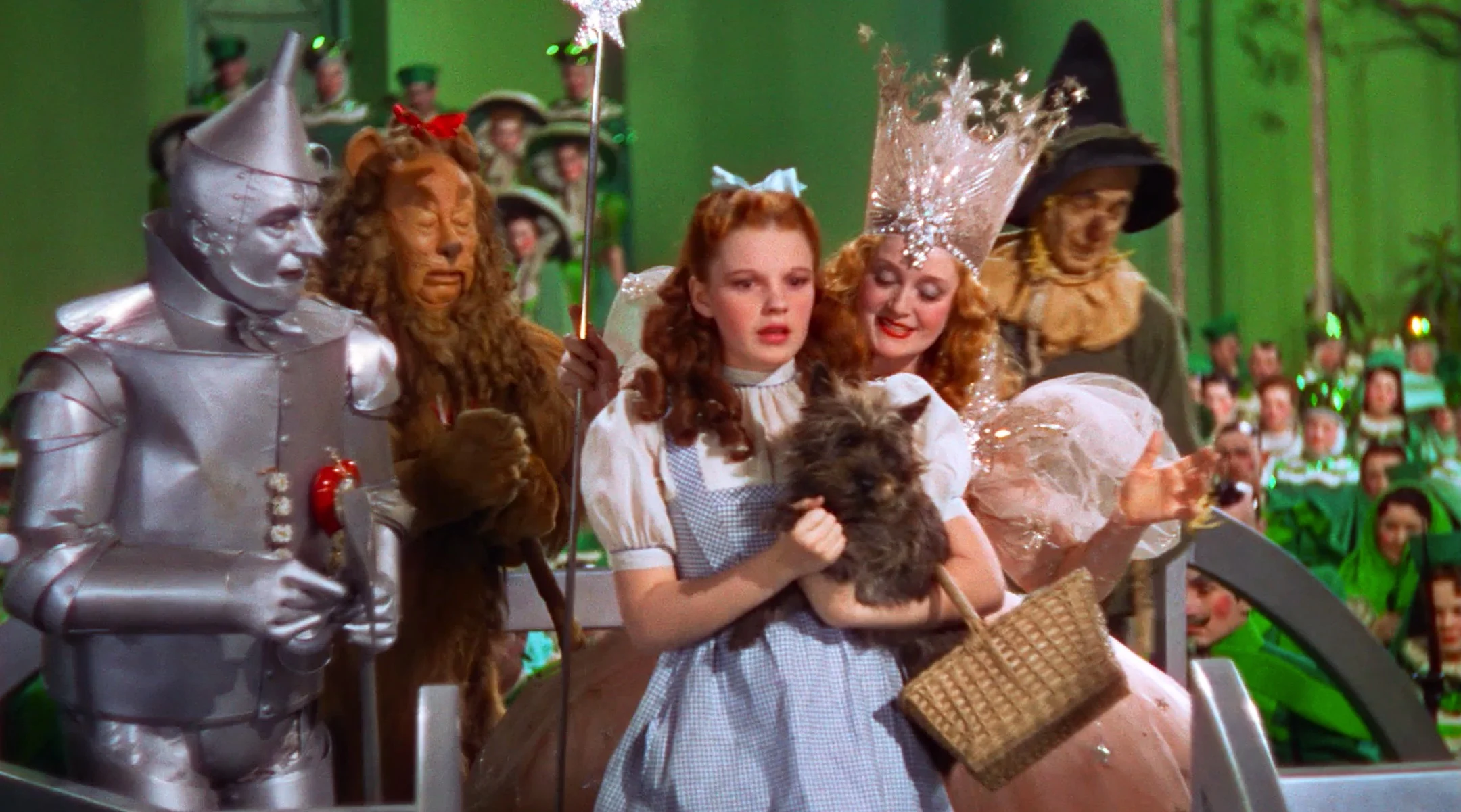
In a 1964 article, educator and historian Henry Littlefield outlined an allegory in the book of the late-19th-century debate regarding monetary policy. According to this view, for instance, the Yellow Brick Road represents the gold standard, and the Silver Shoes (Ruby slippers in the 1939 film version) represent the Silverites' wish to maintain convertibility under a sixteen to one ratio. Hugh Rockoff suggested in 1990 that the novel was an allegory about the demonetization of silver in 1873, and that the City of Oz earns its name from the abbreviation of ounces "Oz" in which gold and silver are measured. The cyclone that carried Dorothy to the Land of Oz represents the economic and political upheaval, the yellow brick road stands for the gold standard, and the silver shoes Dorothy inherits from the Wicked Witch of the East represents the pro-silver movement. When Dorothy is taken to the Emerald Palace before her audience with the Wizard she is led through seven passages and up three flights of stairs, a subtle reference to the Coinage Act of 1873. (via Wikipedia)
There's a form of radio communication that bounces off the trails left by meteors

Meteor Burst Radio is a form of long range radio communication which relies upon the presence of ionised trails in the upper atmosphere to create a radio path. These trails are created by millions of small meteorites as they burn up. The frequencies that can be reflected by any particular ion trail are determined by the intensity of the ionization created by the meteor and are generally between 30 MHz and 50 MHz. The first serious effort to utilize this technique was carried out by the Canadian Defence Research Board in the early 1950s and sent bursts of data pre-recorded on magnetic tape from their radar research station in Saskatchewan to Toronto, a distance exceeding 2,000 km. Worldwide many systems successfully use Meteor Radio to obtain data from remote locations. Most prominent is the US Natural Water Conservation Service system, which consists of over 700 stations in 11 states including Alaska. (via Meteor Communications)
Hi everyone! Mathew Ingram here. I am able to continue writing this newsletter in part because of your financial help and support, which you can do either through my Patreon or by upgrading your subscription to a monthly contribution. I enjoy gathering all of these links and sharing them with you, but it does take time, and your support makes it possible for me to do that. I also write a weekly newsletter of technology analysis called The Torment Nexus.
The anaconda is one of the few animals that is the same size it was 12 million years ago

During the Middle to Upper Miocene period (12.4 to 5.3 million years ago), giant animals walked the Earth thanks to warmer temperatures, larger wetlands, and greater amounts of food. Many of their descendants today are significantly smaller, but anacondas have proven to be unexpectedly stubborn. Researchers investigated 12.4-million-year-old fossils from Venezuela to understand how large ancient anacondas were compared to their relatives today. They found that these early serpents would have been 13 to 16 feet (4 to 5 meters) long on average. That aligns with the usual size of today’s anacondas, meaning these tropical reptiles have remained humongous for millions of years. Unlike other giant species, which reached their peak size during the Miocene before dying out and getting replaced by smaller species in the Pliocene, “large Eunectes has persisted in tropical South America to the present,” the researchers wrote in their study, published in the Journal of Vertebrate Paleontology. (via Gizmodo)
A dentist discovered a hidden code in Leonardo da Vinci’s most famous drawing

Vitruvian Man by Leonardo da Vinci is one of the most iconic images of the Renaissance but still contains plenty of mysteries. Last month, a London-based dentist published his new insight into the work, which may reveal the surprising depth of Leonardo’s understanding of human anatomy many centuries before the advent of modern science. The drawing, inspired by the writings of Roman architect Vitruvius, was produced in around 1490. It uses human anatomy to show how a square and circle could correspond by fitting the idealized male body into both overlaid shapes. Now, Dr. Rory Mac Sweeney has used his professional training to analyze the Vitruvian Man from an new perspective. He believes that the unique drawing “incorporates geometric principles that anticipate modern understanding of optimal biological architecture.” The paper focuses on a third shape within the drawing, that of an equilateral triangle “hiding in plain sight” between the man’s parted legs. (via ArtNet)
A German TV correspondent in 1984 shows how to cross the Place de la Concorde in Paris

Acknowledgements: I find a lot of these links myself, but I also get some from other places that I rely on as "serendipity engines," such as The Morning News from Rosecrans Baldwin and Andrew Womack, Jodi Ettenberg's Curious About Everything, Dan Lewis's Now I Know, Robert Cottrell and Caroline Crampton's The Browser, Clive Thompson's Linkfest and Why Is This Interesting by Noah Brier and Colin Nagy. If you come across something you think should be included here, feel free to email me at mathew @ mathewingram dot com