Lead poisoning may have led to a generation of serial killers


The Pacific Northwest is known for five things: lumber, aircraft, tech, coffee, and crime. What might account for the abrupt rise and equally abrupt fall, between the nineteen-sixties and the turn of the century, of the “golden age” of serial killing? And why were so many of these brutes cradled in a crescent of psychopathy around Seattle’s Puget Sound? Fraser thinks the master key is to be found in the fact that the area south and southwest of Seattle was home to massive ore-processing facilities, and her subjects were reared in their murky shadows. “Spare some string for the smelters and smoke plumes,” she writes of her crazy wall, “those insidious killers, shades of Hades.” The smelters caused a profusion of heavy metals in the air and water, and toxins such as lead and arsenic were found in staggering concentrations in the blood of Tacoma’s children. Some were merely dulled, or delinquent; a few became tabloid monsters. (via the New Yorker)
Spotify changed its randomness algorithm to make it less random but it feels more random

Spotify’s first iteration of its shuffle feature was dictated by a decades-old algorithm that generated unbiased randomness from a finite sequence of elements. Breathtakingly efficient, the Fisher-Yates shuffle was employed by Spotify to dismantle user playlists and reassemble them into new, unpredictable orders. From the developers’ perspective, the task of creating this feature was masterfully accomplished with just a few lines of code. From early users’ perspective, shuffle was a travesty. This discrepancy was bewildering for both parties, but mainly for developers, who had delivered a mathematically perfect version of randomness. Perfection turned out to be the problem. The algorithm captured a Platonic ideal of randomness instead of one compatible with the human mind. We presume that randomness must always be chaotic. However, as randomness is unpredictable, it will at times give the impression of order. (via the FT)
How did hundreds of thousands of pounds of commercial shrimp become radioactive?

In August, the Food and Drug Administration issued an unusual warning: Don’t eat certain lots of frozen shrimp sold at Walmart because they might be radioactive. It didn’t take long for the list of recalled products to grow far beyond Walmart. Over the past six weeks, hundreds of thousands of pounds of frozen, raw, and cooked shrimp have been pulled from supermarket shelves across the U.S. All of the affected shrimp share at least one thing in common: They were processed by an Indonesian firm known as Bahari Makmur Sejati, or BMS Foods. The company may not be well known to consumers, but from January to July, it was responsible for about a third of American shrimp imports from Indonesia—which itself is the third largest exporter of shrimp to the U.S., according to ImportGenius, a trade data analysis company. Over the past month, an investigation has found evidence of widespread radioactive contamination in the area where the shrimp was packaged. (via Consumer Reports)
Hi everyone! Mathew Ingram here. I am able to continue writing this newsletter in part because of your financial help and support, which you can do either through my Patreon or by upgrading your subscription to a monthly contribution. I enjoy gathering all of these links and sharing them with you, but it does take time, and your support makes it possible for me to do that. I also write a weekly newsletter of technology analysis called The Torment Nexus.
MIT scientists have developed a computer made of fabric that can be woven into clothing
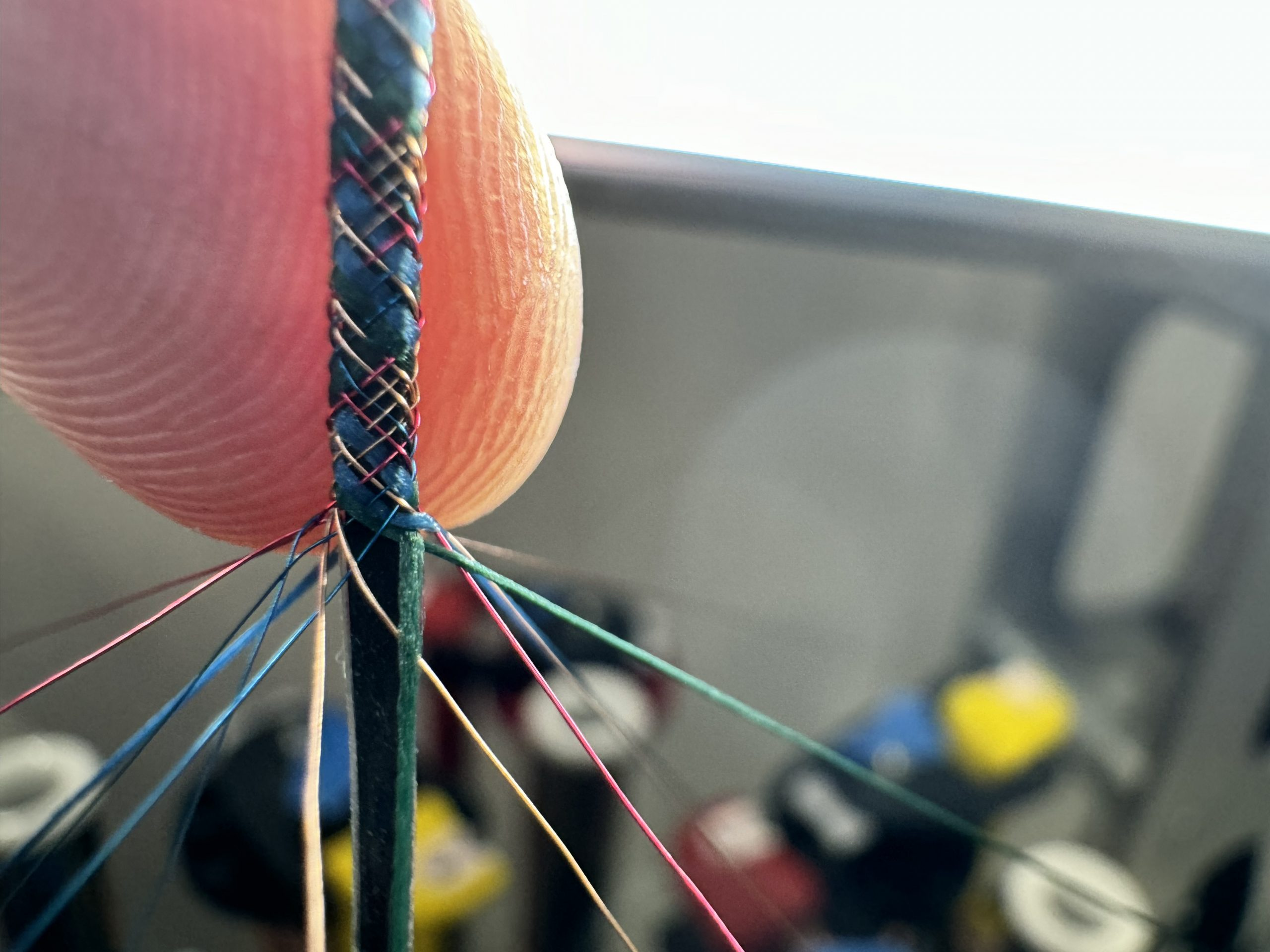
Here a textile fibre computer that monolithically combines analogue sensing, digital memory, processing and communication in a mass of less than 5 g is presented. Enabled by a foldable interposer, the two-dimensional pad architectures of microdevices were mapped to three-dimensional cylindrical layouts conforming to fibre geometry. This programmable fibre, which incorporates a 32-bit floating-point microcontroller, performs edge computing tasks even when braided, woven, knitted or seam-sewn into garments. The assembly process allows for the integration of additional functions with simple modifications, including a rechargeable fibre power source that operates for nearly 6 h. Two wireless communication schemes involve woven optical links and seam-inserted radio-frequency communications. (via MIT)
Why did a 15th century husband commission a statue of his wife's rotting corpse?

There is an unsettling sculpture in Paris' Louvre Museum — a stone carving of a woman's corpse, complete with exposed intestines, maggots, and detailed decay. It is the cadaver monument of Jeanne de Bourbon-Vendôme, a French noblewoman who died in 1511. Jeanne's grieving husband, François de la Pause, commissioned this macabre memorial not because he was a fan of morbid imagery, but because it was common at the time. Medieval "cadaver tombs" showed the deceased twice: once in their earthly glory above, and once as they would appear after death below. Jeanne's tomb originally had both elements, though only the decomposing figure remains in the Louvre today. Such sculptures were designed as a memento mori to remind viewers of the transience and vanity of mortal life compared to the eternity and desirability of the Christian afterlife. (via Boing Boing)
A teenaged inventor built a brain-controlled prosthetic arm for $300

Acknowledgements: I find a lot of these links myself, but I also get some from other newsletters that I rely on as "serendipity engines," such as The Morning News from Rosecrans Baldwin and Andrew Womack, Jodi Ettenberg's Curious About Everything, Dan Lewis's Now I Know, Robert Cottrell and Caroline Crampton's The Browser, Clive Thompson's Linkfest, and Noah Brier and Colin Nagy's Why Is This Interesting. Today a number of the items came from Tom Whitwell's excellent annual 52 Things I Learned This Year list. If you come across something interesting that you think should be included here, please feel free to email me at mathew @ mathewingram dot com