How playing Santa Claus at Macy's changed his life


Santa Claus was nursing a beer at an uptown dive bar. The neighborhood was gentrifying, and management seemed eager to accommodate—there was scented soap in the bathroom and twenty-two-dollar lobster rolls. But the place couldn’t outrun the regulars. They drank tumblers of Irish whiskey filled to the brim, illicit pours they secured with ten-dollar tips to a curvy Dominican bartender. Santa — Billy — was fiftyish, with a modest gut, gray hair, a lustrous beard, and a caddish gaze that followed the bartender up and down the rail. He was dressed in sweatpants and a T-shirt. For the price of three beers, he told me his story. As a young man, Billy had come to New York to be an actor. These were bad years, shameful even. He lost his job. He lost his wife. Lost touch with his young son too. He was overweight and undershaved. A friend had a weird idea: Billy could try playing Santa Claus at Macy’s. And that’s what Billy did. (via Esquire)
It's illegal to sell chewing gum in Singapore and has been since 1992

The sale of chewing gum in Singapore has been illegal since 1992. Some motivations for the ban included stopping the placement of used chewing gum in inappropriate and costly places, such as the sensors of subway doors, inside lock cylinders, and on elevator buttons. Chewing gum was causing maintenance problems in high-rise public-housing apartments, with vandals disposing of spent gum in mailboxes, inside keyholes, and on lift buttons. Gum stuck on the seats of public buses was also considered a problem. Since 2004, an exception has existed for therapeutic, dental, and nicotine chewing gum, which can be bought from a doctor or registered pharmacist. It is not illegal to chew gum in Singapore, but it is against the law to import it and sell it, apart from the aforementioned exceptions. According to a BBC News article, it is legal for a traveler to bring in a small amount of chewing gum for personal use, and there is a fine for spitting the gum out in an inappropriate place. (via Wikipedia)
One expert thinks Ernest Hemingway suffered from chronic traumatic encephelopathy

In his new biography of Ernest Hemingway, Dr. Andrew Farah argues that Hemingway suffered from chronic traumatic encephalopathy (CTE) as the result of numerous severe concussions during his life. He believes this condition not only informed Hemingway’s day-to-day life, interactions, and relationships, but the later literary works as well. There was a fall from the flybridge of his fishing boat while off the coast of Cuba, then a serious car accident in London during the blitz. His head hit the windshield, and he required 57 stitches in the frontal area. There were 3 more concussions during World War II. A German antitank round blew him off a motorbike while he and Robert Capa were on an ill-advised adventure. That incident involved a blast injury as well as blunt trauma. There was another motor vehicle accident in Cuba with his fourth wife and, finally, he and his wife survived 2 plane crashes in Africa during the 1954 safari. The second crash prompted friends to comment on his cognitive decline. (via Psychiatric Times)
Hi everyone! Mathew Ingram here. I am able to continue writing this newsletter in part because of your financial help and support, which you can do either through my Patreon or by upgrading your subscription to a monthly contribution. I enjoy gathering all of these links and sharing them with you, but it does take time, and your support makes it possible for me to do that. I also write a weekly newsletter of technology analysis called The Torment Nexus.
In colonial times penmanship was basically a secret code for social status

Imagine a world in which the font you use is chosen for you, based entirely on your demographic affiliations. All doctors write in Garamond, while designers are mandated Futura Bold. Middle-aged men get Arial; women, Helvetica. Goofy aunts must use Comic Sans. Seem strange? A few centuries ago, that was just how things worked. In colonial America, ”the very style in which one formed letters was determined by one’s place in society,” writes historian Tamara Thornton in Handwriting in America: A Cultural History. Thanks to the rigorous teachings of professionals called “penmen,” merchants wrote strong, loopy logbooks, women’s words were intricate and shaded, and upper-class men did whatever they felt like. So different were the results, Thornton writes, that "a fully literate stranger could evaluate the social significance of a letter… simply by noting what hand it had been written in.” (via Atlas Obscura)
In Switzerland a plan to unify a language spoken by 1 percent of Swiss citizens sparked a war

Spoken by less than one per cent of the Swiss population, the Romansch language was splintered into five major “idioms,” not always readily intelligible to one another, each with its own spelling conventions. Earlier attempts at unification had collapsed in rivalries. In his letter, Cathomas said that Schmid’s authority would be valuable in standardizing the language. Schmid, the man he was counting on, hadn’t grown up speaking Romansh; he first learned it in high school, and later worked on a Romansh dictionary begun in 1904. By the time Cathomas knocked on his door, Schmid had already sketched a plan for standardizing Romansh: a “majority principle” in which the most widely shared spellings would win out. What Cathomas hadn’t reckoned with was how quickly the tidy scheme, once loosed into the valleys, would ignite quarrels that engulfed Swiss classrooms, newspapers, and eventually politics. (via the New Yorker)
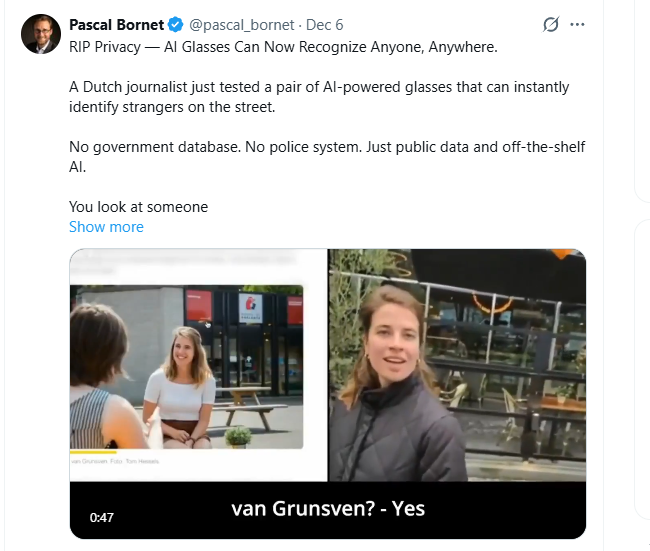
Dutch journalist demonstrates AI-powed glasses with facial recognition
Acknowledgements: I find a lot of these links myself, but I also get some from other places that I rely on as "serendipity engines," such as The Morning News from Rosecrans Baldwin and Andrew Womack, Jodi Ettenberg's Curious About Everything, Dan Lewis's Now I Know, Robert Cottrell and Caroline Crampton's The Browser, Clive Thompson's Linkfest and Why Is This Interesting by Noah Brier and Colin Nagy. If you come across something you think should be included here, feel free to email me at mathew @ mathewingram dot com