He thought he found gold but it was a 5 billion-year-old meteor


In 2015, David Hole was prospecting in Maryborough Regional Park near Melbourne, Australia. Armed with a metal detector, he discovered something out of the ordinary – a very heavy, reddish rock resting in some yellow clay. He took it home and tried everything to open it, sure that there was a gold nugget inside the rock – after all, Maryborough is in the Goldfields region, where the Australian gold rush peaked in the 19th century. Hole tried a rock saw, an angle grinder, a drill, and even doused the thing in acid. Unable to open the rock, Hole took the nugget to the Melbourne Museum for identification. A scientist there said that after 37 years of working at the museum and examining thousands of rocks, only two of the offerings had ever turned out to be real meteorites, and Hole's rock was one of those two. He published a scientific paper describing the 4.6 billion-year-old meteorite, which he called Maryborough. (via ScienceAlert)
In the 16th century cadavers were embalmed with honey and then turned into medicine

A mellified man, also known as a human mummy confection, was a legendary medicinal substance created by steeping a human cadaver in honey. The concoction is detailed in Chinese medical sources of the 16th century, which reports that some elderly men in Arabia, nearing the end of their lives, would submit themselves to a process of mummification in honey to create a healing confection. The mellification process would ideally start before death. The donor would stop eating any food other than honey, going as far as to bathe in the substance. Shortly, the donor's feces and even sweat would consist of honey. When this diet finally proved fatal, the donor's body would be placed in a stone coffin filled with honey. After a century or so, the contents would have turned into a sort of confection reputedly capable of healing broken limbs, which would then be sold in street markets at a hefty price. (via Wikipedia)
Famous avant-garde composer Philip Glass also worked as a plumber and cab driver

In 2011, Glass was questioned about his day jobs as taxi driver and plumber. He recalls: “While working, I suddenly heard a noise and looked up to find Robert Hughes, the art critic of Time magazine, staring at me in disbelief. ‘But you’re Philip Glass! What are you doing here?’ It was obvious that I was installing his dishwasher and I told him I would soon be finished. ‘But you are an artist,’ he protested. I explained that I was an artist but that I was sometimes a plumber as well and that he should go away and let me finish.” As Clay Wirestone of Mental Floss describes, “Even after the premiere of his opera Einstein at the Beach at the Met in 1976, the 39-year-old Glass went back to driving a cab. He kept at it for the next three years.” . He continued working as a cab driver after becoming famous because he did not have an agent and was managing all business aspects himself. He eventually stopped driving to pursue other commissions and to establish a publishing company to handle his affairs. (via Improvised Life)
Hi everyone! Mathew Ingram here. I am able to continue writing this newsletter in part because of your financial help and support, which you can do either through my Patreon or by upgrading your subscription to a monthly contribution. I enjoy gathering all of these links and sharing them with you, but it does take time, and your support makes it possible for me to do that. I also write a weekly newsletter of technology analysis called The Torment Nexus.
Beware the Yule Cat — Iceland’s child-eating Christmas monster
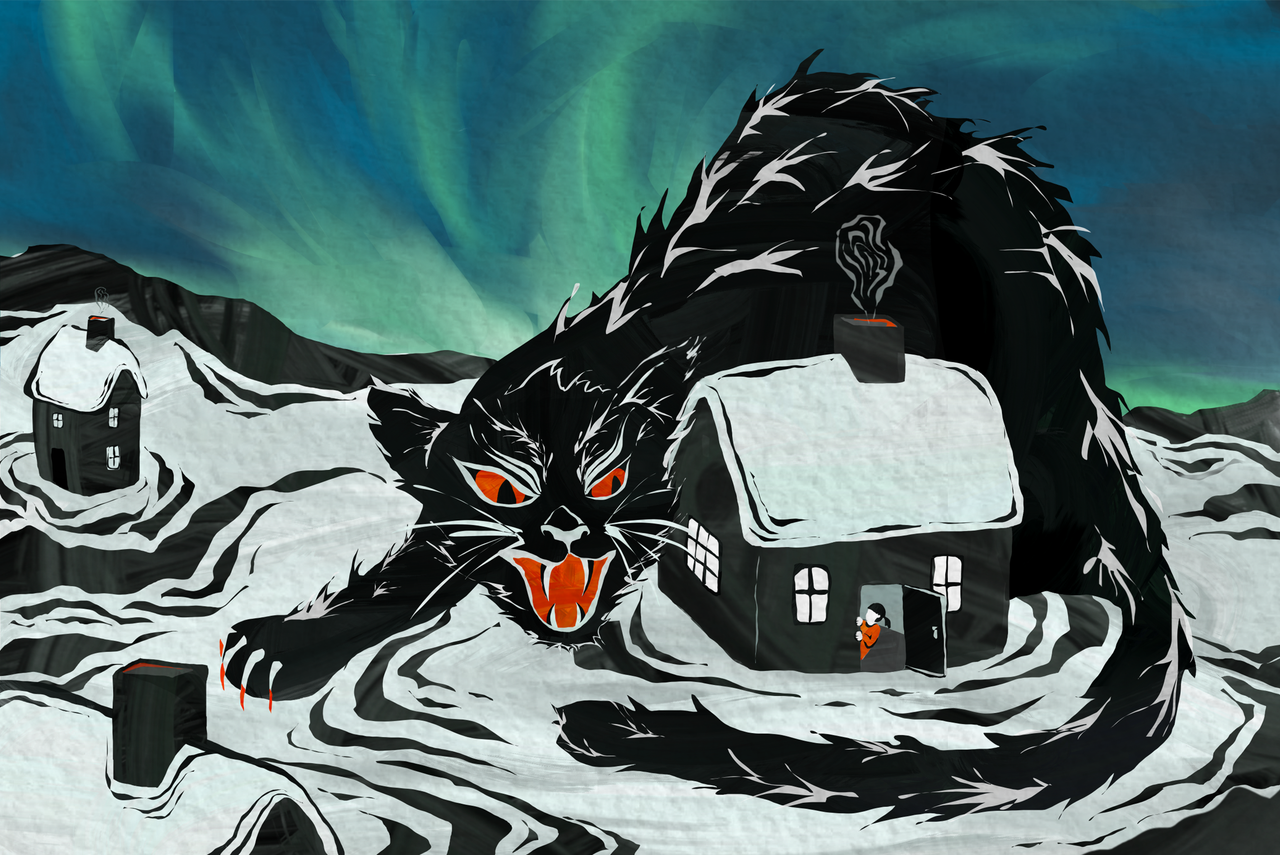
If you thought the ghost-filled plot of A Christmas Carol was a bit macabre for the holidays, you may want to steer clear of visiting Iceland anytime in December, when the stories turn to Iceland’s meanest Christmas tale: Jólakötturinn, or the child-eating Yule Cat, a black cat the size of a house that roams the Icelandic countryside on Christmas Eve, attacking and eating children who fail to wear at least one new piece of clothing. The Yule Cat is something of a bribe for children: be good, and you’ll get a new sweater or pair of socks on Christmas. But if you misbehave, bad news: not only will you not get a new sweater, but you’ll be eaten by Jólakötturinn. The idea of a 12-foot-tall, bloodthirsty cat may not seem like a great fit with Christmas good cheer. But in a country where a third of residents report a belief in hidden people and an entire school devoted to studying elves, Jólakötturinn starts to make sense. (via Atlas Obscura)
Mark Twain used fingerprints as a crime-solving device years before police did

The first American writer to use fingerprints in solving crime was the famous Mark Twain in his perhaps-embellished memoir about life as a steamboat pilot, titled Life on the Mississippi, published in 1883. In chapter 31, “A Thumb-print and What Came of It,” he has a character, inspired by an old “French prison-keeper” use a fingerprint to detect and prove a murderer’s identity ten years ahead of its adoption by the world-at-large. The first real-life crime solved using fingerprints was in Argentina in 1892 by detective Juan Vucetich, who began creating files of Galton print patterns, and even Bertillon measurements. He confronted a murderess with her fingerprint, and she confessed. In 1893, Twain wrote another, serialized story for The Century Magazine, called “Pudd’nhead Wilson and Those Extraordinary Twins.” In this story, a young lawyer, David Wilson, is nicknamed Pudd’nhead and has a silly preoccupation with collecting everyone’s fingerprints on glass slides. (via Criminal Element)
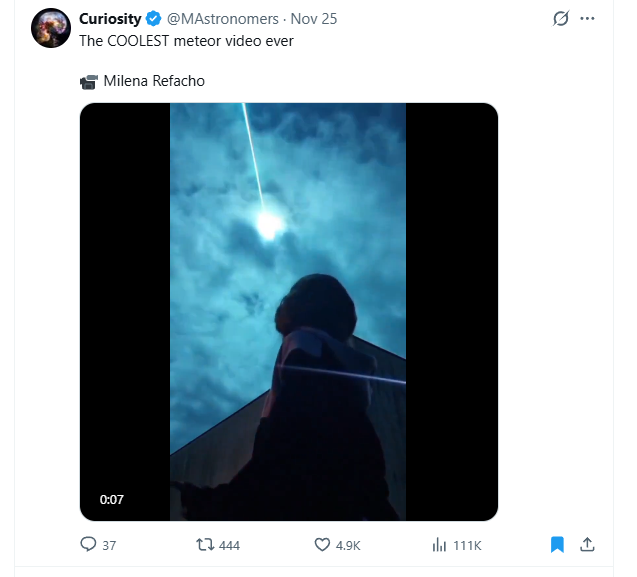
One of the best meteor videos you will see
Acknowledgements: I find a lot of these links myself, but I also get some from other newsletters that I rely on as "serendipity engines," such as The Morning News from Rosecrans Baldwin and Andrew Womack, Jodi Ettenberg's Curious About Everything, Dan Lewis's Now I Know, Robert Cottrell and Caroline Crampton's The Browser, Clive Thompson's Linkfest, Noah Brier and Colin Nagy's Why Is This Interesting, Maria Popova's The Marginalian, Sheehan Quirke AKA The Cultural Tutor, the Smithsonian magazine, and JSTOR Daily. If you come across something interesting that you think should be included here, please feel free to email me at mathew @ mathewingram dot com