He has Parkinson's but his identical twin brother doesn't


While a handful of genetic mutations are linked to the disease, about 90 percent of cases of Parkinson’s are “sporadic,” meaning the disease does not run in the family. In one of the largest longitudinal twin studies of the disease, Swedish scientists reported in 2011 that of 542 pairs in which at least one twin had Parkinson’s, the majority were “discordant,” meaning that the second twin was unaffected. But the environmental connection is precisely what makes Jack and Jeff so interesting. For almost all of their 68 years, they have lived no more than half a mile apart. They have been exposed to the same air, the same well water, the same dusty farm chores, the same pesticides. They built their homes a five-minute walk from each other. And since 1971 they have worked in the same office, their desks pushed together, at a graphic design firm. (via Nautilus)
This tiny British deer barks like a dog and has fangs even though it is a vegetarian

Muntjacs are a small stocky type of deer, widespread in British woodlands. They are often overlooked because, being just 50cm high and no bigger than a medium-sized dog, they are hidden by tall vegetation for much of the summer. Muntjac deer are herbivores, and enjoy trees and shrubs, shoots, herbs, berries, nuts and fungi. Muntjac are extremely vocal, hence their other name ‘barking deer’. Though it is called a ‘bark’, the sound is more like a scream and can be mistaken for a fox. Odd though these adaptations are, it is the ‘fangs’ that really seem out of place. Most prominent in the adult male, the elongated upper canines are up to 6cm long. Whereas most male deer use antlers to fight and display their fitness, the male muntjac has only an elementary set. Once again, the tangle of shrubby habitats preferred by this species explains why. Big antlers would simply be impractical; the fangs are for close-up combat. (via Discover Wildlife)
He tried to turn his daughters into geniuses and all three are now world-class chess players

Having studied the nature of intelligence at university, educational psychologist László Polgar got it in his head that, since most geniuses started learning their subjects intensively and early, parents could cultivate genius-level performance in their children by directing that learning process themselves. Chess became the project’s central subject in large part because of its sheer objectivity. For his daughters, Polgár has emphasized, learning involved none of the drudgery and busywork of school. “A child does not like only play: for them it is also enjoyable to acquire information and solve problems,” he writes. The proof of Polgár’s theories is in the pudding — or at any rate, in the ratings. All three of his daughters became elite chess players. Sofia became the sixth-strongest female player in the world; Susan the top-ranked female player in the world; Judit, the youngest, the strongest female chess player of all time. (via Open Culture)
Hi everyone! Mathew Ingram here. I am able to continue writing this newsletter in part because of your financial help and support, which you can do either through my Patreon or by upgrading your subscription to a monthly contribution. I enjoy gathering all of these links and sharing them with you, but it does take time, and your support makes it possible for me to do that. I also write a weekly newsletter of technology analysis called The Torment Nexus.
Sony's first product was an electric rice cooker that either undercooked or overcooked the rice

In October, Ibuka and his group established a new facility, called the Tokyo Telecommunications Research Institute. Although everyone was eager to work for the new company and to help rebuild post-war Japan with their engineering know-how, no one knew what to do at first. So Ibuka's factory worked on an electric rice cooker. As the war plants had closed down, there was more electricity than was needed at the time. This surplus fed Ibuka's desire to produce items which were needed for everyday life. The electric rice cooker, made by merely interlocking aluminum electrodes which were connected to the bottom of a wooden tub, was a primitive product. Tasty rice was a rarity, as the rice cooker produced mostly undercooked or overcooked rice. The rice needed for development of the cooker was bought by Shozaburo Tachikawa on the black market. (via Sony.com)
Roly-poly pillbugs aren't insects at all but are more closely related to crabs and shrimp
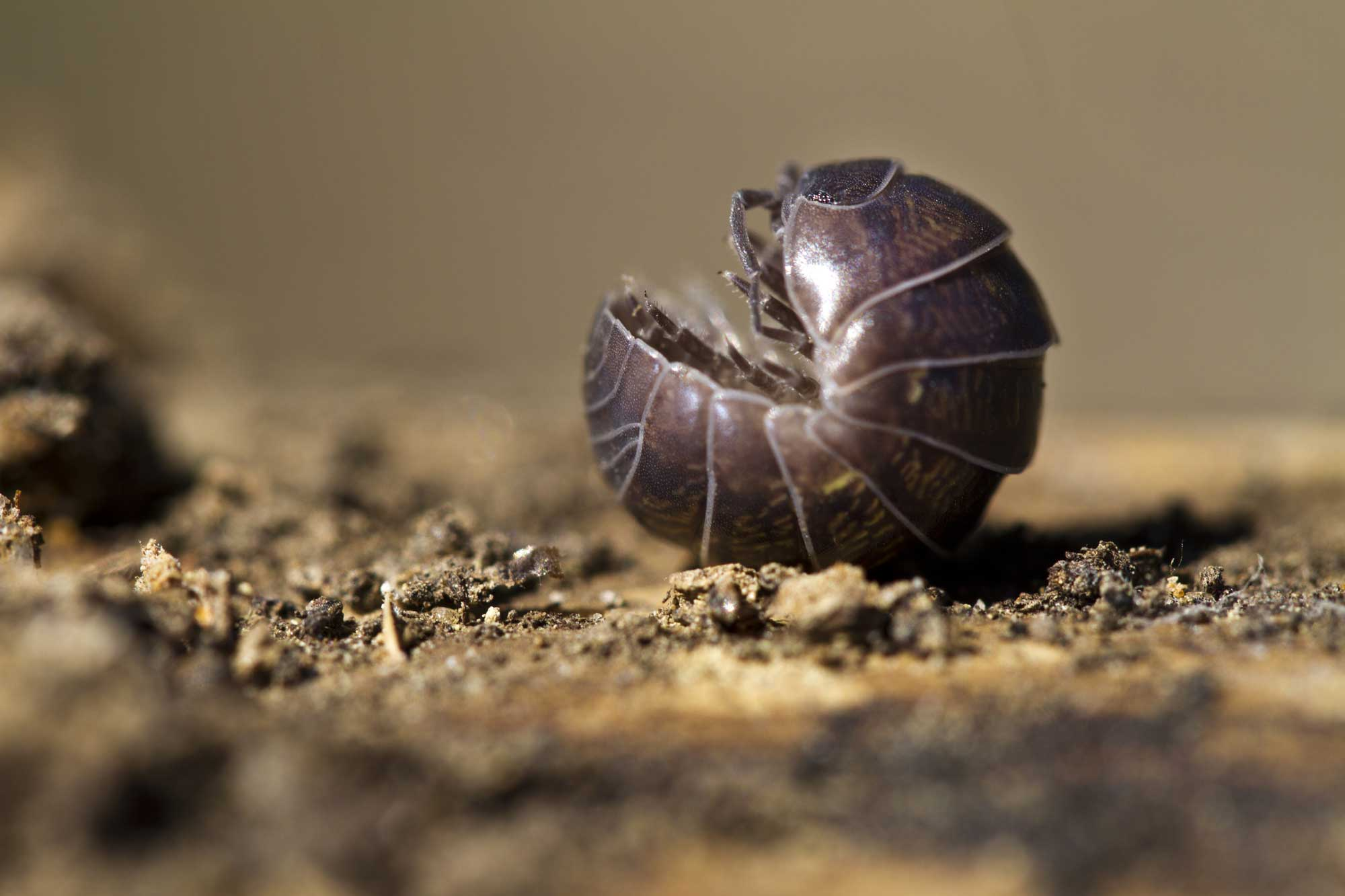
Roly-poly is a common nickname for these tiny creatures, but it's certainly not the only name they go by. Some people call them wood shrimp or doodlebugs, and in England they have dozens of nicknames, including chiggypigs, penny sows and cheesybugs. The official name for these creatures is pillbug. They are also sometimes called woodlice, because they are often found under logs. Pillbugs are sometimes also referred to as sowbugs, although they are two separate species (one key difference is that pillbugs can roll themselves into a ball, while sowbugs cannot). They are actually crustaceans, which means they are more closely related to shrimp, crabs and crayfish than they are to ants and other insects. Roly-polies are terrestrial crustaceans, and are the only crustaceans that have adapted to living entirely on land. (via Reconnect With Nature)
This little robot stamps its feet so builders can test their soundproofing

Acknowledgements: I find a lot of these links myself, but I also get some from other places that I rely on as "serendipity engines," such as The Morning News from Rosecrans Baldwin and Andrew Womack, Jodi Ettenberg's Curious About Everything, Dan Lewis's Now I Know, Robert Cottrell and Caroline Crampton's The Browser, Clive Thompson's Linkfest and Why Is This Interesting by Noah Brier and Colin Nagy. If you come across something you think should be included here, feel free to email me at mathew @ mathewingram dot com