ALS stole his voice but AI let him sing again one more time


There are tears in the audience as Patrick Darling’s song begins to play. It’s a heartfelt song written for his great-grandfather, whom he never got the chance to meet. But this performance is emotional for another reason: It’s Darling’s first time on stage with his bandmates since he lost the ability to sing two years ago. The 32-year-old musician was diagnosed with amyotrophic lateral sclerosis (ALS) when he was 29 years old, which affects the nerves that supply the body’s muscles. People with ALS eventually lose the ability to control their muscles, including those that allow them to move, speak, and breathe. Darling’s last stage performance was over two years ago. By that point, he had already lost the ability to stand and play his instruments and was struggling to sing or speak. But recently, he was able to re-create his lost voice using an AI tool trained on snippets of old audio recordings. (via MIT Tech Review)
A woman lived undetected inside the sign on top of a Michigan store for more than a year

A woman who had been living in a sign of a Michigan grocery store for about a year was captured on police body cam footage telling police it was a “safe spot” for her to live. The saga began about a month ago when a contractor working on the roof of the Family Fare store in Midland noticed an extension cord running into a door on the back of the sign. When he opened the door, he was greeted by the 34-year-old woman. Officer Brennon Warren of the Midland Police Department told The Associated Press that the woman had made herself quite comfortable in the sign’s approximate 40-square feet. “There was some flooring that was laid down. A mini desk,” he said. “Her clothing. A Keurig coffee maker. A printer and a computer — things you’d have in your home.” Police did not name the woman, but said she was cooperative and agreed to leave. She was not charged with any crimes. the woman told officers she’d been living in the sign for about a year, but officers never learned how she was accessing the roof every day. (via Global News)
Scientists still aren't sure why curling stones move the way they do

The icy ballet of stone upon ice makes curling one of the most intriguing sports of the Winter Olympics. But scientists still haven't quite figured out the physics of how they move. For a sport that dates from the 1500s, it's surprising to learn that we've still not worked out how curling works. The Winter Olympic sport – first played on frozen lochs in Scotland centuries ago – involves launching hunks of granite across a rough icy surface, so that they drift and bend into a target known as the house. Players sweep brooms in front of each stone to control its trajectory. This seems simple enough, but as curling coaches themselves acknowledge, there are still many unknowns about the physics of the sport. So while the basic tactics are agreed, there are often divides and controversies about the most effective techniques, even at a high level. Of all the scientific mysteries, one of the biggest speaks to the name of the sport itself: how and why do the stones curl? If a player spins a stone clockwise at the moment of launch, it will curl to the right towards the end of its journey, or vice versa. (via the BBC)
Hi everyone! Mathew Ingram here. I am able to continue writing this newsletter in part because of your financial help and support, which you can do either through my Patreon or by upgrading your subscription to a monthly contribution. I enjoy gathering all of these links and sharing them with you, but it does take time, and your support makes it possible for me to do that. I also write a weekly newsletter of technology analysis called The Torment Nexus.
The name for the man on the Pringles can started out as a joke

Across the top of each can, above the “Pringles” wordmark, is a man with floating eyebrows and a very pronounced mustache. His name is Julius Pringles. The name has a good sound to it — it’s distinguished, maybe even Victorian. It’s the kind of name you’d expect from a man whose entire personality is “arched eyebrows and a bow tie." But it started as a joke. In December 2006, two college kids, Justin Shillock and Michael Wiseman, were sitting in their dorm room watching a football game and eating some Sour Cream & Onion Pringles. That’s when, per Input Magazine, Justin asked a seemingly innocuous question — he wanted to know what Michael thought the Pringles guy’s name was. Not having a clue, Michael noted that one of the football players on the screen was named Julius Peppers, so he simply replied “Julius Pringles.” Justin decided to take the remark one step further. A long-time Wikipedia editor, he added this “fact” to the Pringles entry in the online encyclopedia. (via Now I Know)
Skiing has been around for over eight thousand years and was invented before the wheel
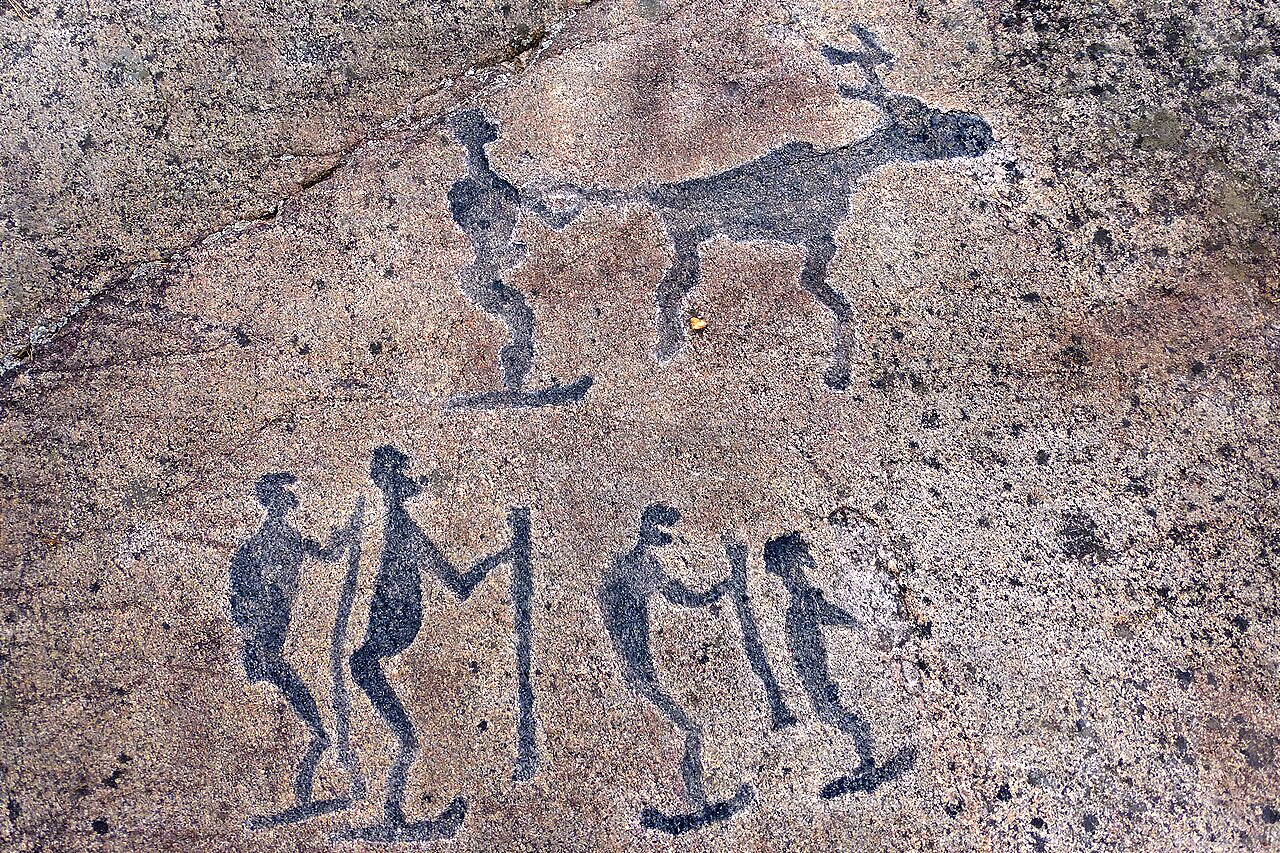
Skiing has a history of at least eight millennia. The geographic origins of skiing are disputed. Anthropologists and ski historians most commonly identify two proposed regions of origin: Scandinavia and the Altaic region of northern Asia. The earliest archaeological examples of skis were found in Karelia (a region in western Russia on the border with Finland) and date to 6000 BCE. Stone Age cliff paintings from the Altai Mountains in northwest China, dated to at least 4000 years old, depict hunters using primitive skis and are often cited as evidence that skiing may have independantly developed in Central Asia. Norse mythology describes the god Ullr and the goddess Skaði hunting on skis. Ullr and Skaði have later been regarded as the god and goddess of skiing and hunting. Early historical evidence includes Procopius' (around CE 550) description of Sami people as skrithiphinoi or "ski running samis." (via Wikipedia)
Chinese shopping influencers hold the product in front of a green screen and AI does the rest

Acknowledgements: I find a lot of these links myself, but I also get some from other places that I rely on as "serendipity engines," such as The Morning News from Rosecrans Baldwin and Andrew Womack, Jodi Ettenberg's Curious About Everything, Dan Lewis's Now I Know, Robert Cottrell and Caroline Crampton's The Browser, Clive Thompson's Linkfest and Why Is This Interesting by Noah Brier and Colin Nagy. If you come across something you think should be included here, feel free to email me at mathew @ mathewingram dot com