After she killed her husband she wrote a book on grief

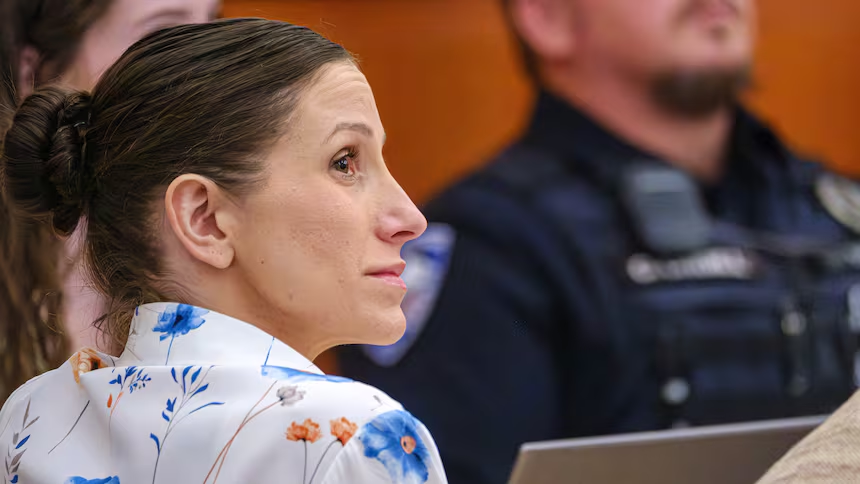
A Utah woman who wrote a children's book about coping with grief after her husband's death was convicted of aggravated murder in his death by poisoning him with fentanyl. Jurors on Monday also found Kouri Richins guilty of fraudulently claiming insurance benefits after the death of Eric Richins in March 2022 at their home outside the ski town of Park City. Prosecutors say Kouri Richins slipped five times the lethal dose of the synthetic opioid into a cocktail that he drank. She was also convicted of other felony charges, including an attempted murder charge in what authorities alleged was another effort to poison her husband weeks earlier on Valentine's Day with a fentanyl-laced sandwich. Richins was $4.5 million US in debt and falsely believed that when her husband died, she would inherit his estate worth more than $4 million US. After her husband's death, Richins self-published a children's book about grief to help her sons and other kids cope with the loss of a parent. (via the CBC)
That time the Soviet Union fired a secret space cannon while in orbit

A quarter-century after the Cold War came to a close, the only cannon that actually fired in space has finally come to light. Installed on the Almaz space station in the 1970s, the R-23M Kartech was derived from a powerful aircraft weapon; Aron Rikhter designed the original 23-millimeter cannon for the Tupolev Tu-22 Blinder supersonic bomber. That gun is relatively well known, but its space-based cousin has largely remained in obscurity. From the dawn of the Space Age, the prospect of American spacecraft approaching and inspecting Soviet military satellites—which, according to the Kremlin’s propaganda, were not even supposed to exist—terrified the secrecy-obsessed Soviet military. A team of scientists developed a 14.5-millimeter rapid-fire cannon that reportedly could hit targets as far as two miles away. Depending who you ask, the 37-pound weapon could fire from 950 to 5,000 shots per minute, blasting 200-gram shells at a velocity of 690 meters per second. (via Popular Mechanics)
There are certain number combinations that are considered to be illegal

An illegal number is a number that represents information which is illegal to possess, utter, propagate, or otherwise transmit in some legal jurisdiction. Any piece of digital information is representable as a number; consequently, if communicating a specific set of information is illegal in some way, then the number may be illegal as well. A number may represent some type of classified information or trade secret, legal to possess only by certain authorized persons. An AACS encryption key (09 F9 11 02 9D 74 E3 5B D8 41 56 C5 63 56 88 C0) that came to prominence in May 2007 is an example of a number whose publication or inappropriate possession is claimed to be illegal in the United States. It assists in the decryption of any HD DVD or Blu-ray Disc released before this date. The issuers of a series of cease-and-desist letters claim that the key itself is therefore a copyright circumvention device, and that publishing the key violates the US Digital Millennium Copyright Act. (via Wikipedia)
Hi everyone! Mathew Ingram here. I am able to continue writing this newsletter in part because of your financial help and support, which you can do either through my Patreon or by upgrading your subscription to a monthly contribution. I enjoy gathering all of these links and sharing them with you, but it does take time, and your support makes it possible for me to do that. I also write a weekly newsletter of technology analysis called The Torment Nexus.
Researchers documented a case where a man could make his pupils larger on command

A student of psychology at Ulm University, D.W., presented himself to one of the authors stating that he is able to change his pupils on command. The young man is 23 years old and presented without acute psychiatric or neurological disorder. Binocular vision was without pathological findings, though, with a slight left-eye dominance. He reported that he had first experienced his ability to change pupil size voluntarily at the age of around 16. It happened in the context of excessive computer gaming sessions when he tried to “relax” his eyes by rolling and performing voluntary saccades. In the presence of a friend he found out that the size of his left pupil had changed and was smaller than the pupil of the right eye. D.W. then repeatedly tried to change pupil size in the absence of rolling maneuvers. At this time, he was unaware that he produced changes in pupil size in both directions, that is, larger and smaller. (via Science Direct)
The internet made fun of her Olive Garden review then Anthony Bourdain stepped in

Grand Forks, North Dakota is the third-most populous city in the state, which is to say, it’s not all that big. Just under 60,000 people live there – hardly the place you’d think of going to if you wanted a great meal. Which is why it’s so strange that the book “Grand Forks: A History of American Dining in 128 Reviews” exists. Marilyn Hagerty was a lifelong newspaper columnist at the Grand Forks Herald. Her restaurant reviews were, understandably, intended for local audiences — even today, the Grand Forks Herald has a circulation of only about 15,000. So it made perfect sense, that, on March 6, 2012, Hagerty wrote a story about the newest restaurant to come to town — an Olive Garden. For this, many online mocked her — an 85-year-old woman, living in a small, forgettable city, making a big to-do over an Olive Garden? How… ridiculous. And then an unexpected ally stepped in: Anthony Bourdain. Bourdain said his first instinct was to sneer at the review, but he called her reaction ‘dignified.’ (via Now I Know)
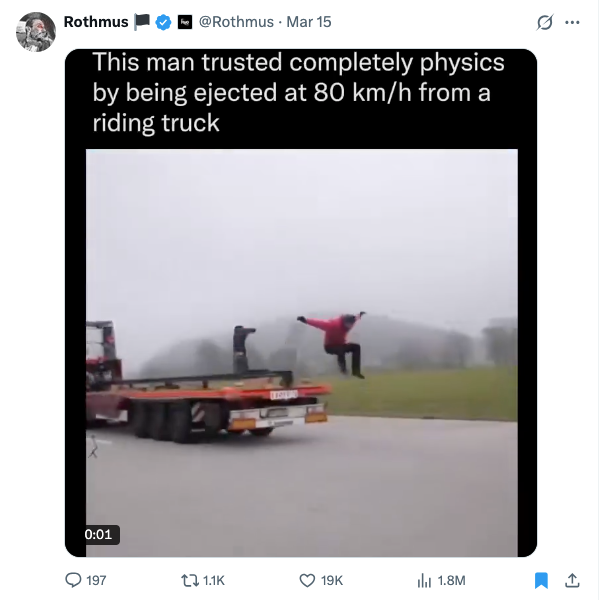
What happens when you are ejected from a moving truck at 80 km/h
Acknowledgements: I find a lot of these links myself, but I also get some from other places that I rely on as "serendipity engines," such as The Morning News from Rosecrans Baldwin and Andrew Womack, Jodi Ettenberg's Curious About Everything, Dan Lewis's Now I Know, Robert Cottrell and Caroline Crampton's The Browser, Clive Thompson's Linkfest and Why Is This Interesting by Noah Brier and Colin Nagy. If you come across something you think should be included here, feel free to email me at mathew @ mathewingram dot com