A teenaged girl struck out Babe Ruth and Lou Gehrig in 1931

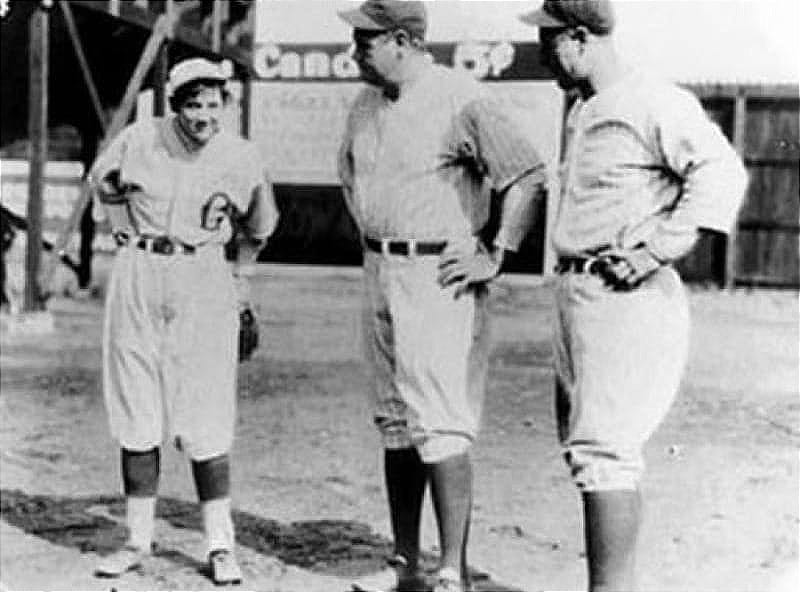
When World War II came to America, baseball was one of the early victims. Many Major League players were in their early 20s and, therefore, subject to the draft. the owner of the Cubs, Philip K. Wrigley (of chewing gum fame) started the All-American Girls Professional Baseball League in 1943. While many know about the AAGPBL due to the 1992 movie A League of Their Own, few realize that women played professional, minor league baseball until 1931. That year, a young woman named Jackie Mitchell ended women's hopes of breaking into the big leagues. How? By striking out Babe Ruth. And, for good measure, she struck out Lou Gehrig too. Ruth, then 36 years old and on the downside of his career, led the league in home runs with 46 – but it was a tie. The other guy to also hit 46 homers was Gehrig, a 28 year old first baseman, and Ruth's teammate on the New York Yankees. (via Now I Know)
The name of the Chicxulub meteor crater was chosen because it's hard to pronounce

The Chicxulub crater is an impact crater buried underneath the Yucatán Peninsula in Mexico. Its center is offshore, but the crater is named after the onshore community of Chicxulub Pueblo. It was formed slightly over 66 million years ago when an asteroid, about ten kilometers in diameter, struck Earth. The crater is estimated to be 200 kilometers in diameter and is buried to a depth of about 1 kilometer beneath younger sedimentary rocks. It is one of the largest impact structures on Earth. The crater was discovered by Antonio Camargo and Glen Penfield, geophysicists who had been looking for petroleum in the Yucatán Peninsula during the late 1970s. Hildebrand, Penfield, Boynton, Camargo, and others published their paper identifying the crater in 1991. Penfield recalled that part of the motivation for the name Chicxulub was "to give the academics and NASA naysayers a challenging time pronouncing it" after years of dismissing its existence. (via Wikipedia)
California teenager discovers 1.5 million unidentified space objects

Matteo Paz, a student at Pasadena High School, joined the Planet Finder Academy in the summer of 2022. The program immerses students in real world astronomy challenges. Under the mentorship of Caltech scientist Davy Kirkpatrick at the Infrared Processing and Analysis Center (IPAC), Paz examined a massive archive from NASA’s NEOWISE telescope. Launched in 2009 to detect near Earth asteroids, NEOWISE collected a decade of full sky infrared observations. The dataset contained nearly 200 billion rows of measurements, capturing countless celestial objects and distant phenomena. While the research team initially planned to study a small subset manually, Paz designed a more ambitious approach. Drawing on his background in theoretical math, coding and time series analysis, he built an automated algorithm to process the archive. In six weeks, he created a machine-learning pipeline capable of detecting faint, variable light sources – objects whose brightness changes too subtly or unpredictably for humans or standard software to catch. (via Futura Sciences)
Hi everyone! Mathew Ingram here. I am able to continue writing this newsletter in part because of your financial help and support, which you can do either through my Patreon or by upgrading your subscription to a monthly contribution. I enjoy gathering all of these links and sharing them with you, but it does take time, and your support makes it possible for me to do that. I also write a weekly newsletter of technology analysis called The Torment Nexus.
Russia hid a secret listening device in an artwork it gave the US ambassador

Eighty years ago, during the final weeks of World War Two, a troop of Russian boy scouts presented the US Ambassador in Moscow with a hand-carved Great Seal of the US, at his official residence – Spaso House. The gift symbolised cooperation between Russia and the US during the war, and the US Ambassador W Averell Harriman proudly hung it in his house until 1952. But unbeknownst to the ambassador and his security team, the seal contained a covert listening device, later dubbed "The Thing" by US technical security teams. It spied on diplomatic conversations, completely undetected for seven years. How did The Thing work? John Little, a 79-year-old specialist in counter-surveillance, describes the technology of The Thing in musical terms – as being composed of tubes like organ pipes and a membrane "like the skin of a drum, that will vibrate to the human voice". But it was compacted into a tiny object that looks like a hat pin – and with the advantage of passing unnoticed by counter-surveillance screening. (via the BBC)
Why are hours and minutes divided into sixty parts? Blame the Babylonians

The concept of fixed-length hours did not originate until the Hellenistic period, when Greek astronomers began using such a system for their theoretical calculations. Hipparchus, whose work primarily took place between 147 and 127 B.C., proposed dividing the day into 24 hours, based on the 12 hours of daylight and 12 hours of darkness observed on equinox days. Despite this suggestion, laypeople continued to use seasonally varying hours for many centuries. Hipparchus and other Greek astronomers employed astronomical techniques that were previously developed by the Babylonians. The Babylonians made astronomical calculations in the sexagesimal (base 60) system they inherited from the Sumerians, who developed it around 2000 B.C. Although it is unknown why 60 was chosen, it is notably convenient for expressing fractions, since 60 is the smallest number divisible by the first six counting numbers as well as by 10, 12, 15, 20 and 30. (via Scientific American)
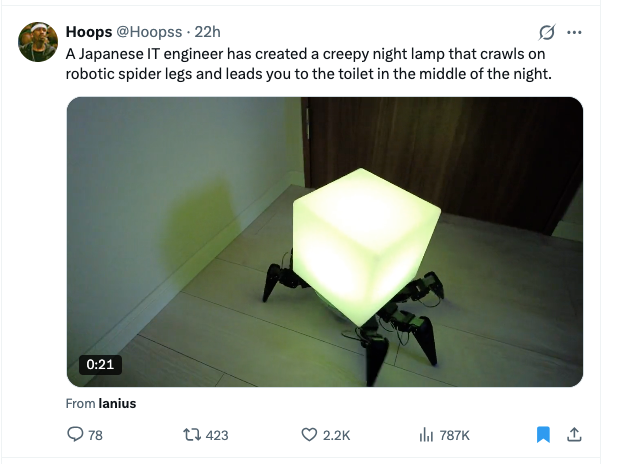
A Japanese engineer created a night lamp that crawls on robotic spider legs
Acknowledgements: I find a lot of these links myself, but I also get some from other places that I rely on as "serendipity engines," such as The Morning News from Rosecrans Baldwin and Andrew Womack, Jodi Ettenberg's Curious About Everything, Dan Lewis's Now I Know, Robert Cottrell and Caroline Crampton's The Browser, Clive Thompson's Linkfest and Why Is This Interesting by Noah Brier and Colin Nagy. If you come across something you think should be included here, feel free to email me at mathew @ mathewingram dot com