A skull sitting in a bank vault in Paris could be Henry IV's


After his assassination on May 14, 1610, King Henry IV was embalmed and prepared for the grave. This was followed by about seven weeks of preparation and ceremony before he was buried at the basilica of Saint Denis, the traditional resting place of French kings. And there he rested until 1793, when the Revolution came calling. The government decided to celebrate the one year anniversary of the First Republic by desecrating the graves of all the royals buried at Saint Denis. When they opened his tomb, Henri’s body was apparently in a remarkable state of preservation. So much so they supposedly made a new death mask from his well-preserved face! They even propped him up for two days on display before adding him to the mass grave. Time passed, Napoleon did his thing, and Louis XVIII, who was Louis XVI‘s brother, was on the throne. As a Bourbon, he wanted to honor his ancestors and have the bones dug up and placed back in Saint Denis. And here’s where it gets even weirder. (via Paris Gone By)
What it's like to take a guided tour of an abandoned shopping mall
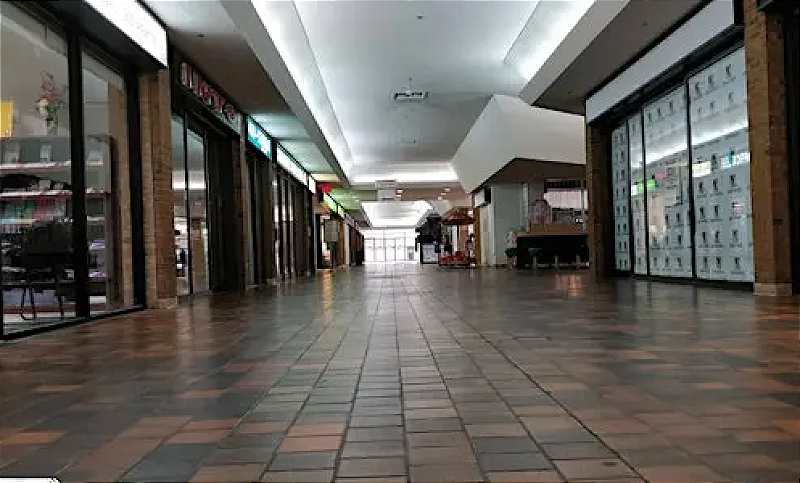
Aryeh is here to take us to the mall — or, more accurately, to several malls, most of which are almost completely abandoned. In his spare time, he runs an organization called Liminal Assembly, which shuttles people through a series of decaying suburban shopping malls around the Greater Toronto Area, places that seem stuck in purgatory. Last winter, I stumbled upon an Instagram post advertising a party being held at an aging retail complex in Toronto’s Yorkville neighbourhood. Cumberland Terrace had somehow occupied the corner of Bay and Bloor Streets since the 1970s, wedged between luxury towers and some of Canada’s most expensive commercial real estate. I’d cut through its ghostly pathways hundreds of times en route to the subway, perplexed by its perpetually shuttered food court and wall of pay phones, its increasingly dwindling storefronts. It seemed out of place, occupying neither past nor present. (via Hazlitt)
He went for a hike and stumbled on a 1,400-year-old reindeer trap

Over 1,500 years ago, the people living high on Norway’s Aurlandsfjellet mountain plateau had worked out an effective reindeer trapping system, but descending frigid weather concealed it for over a millennium. But the melting Norwegian ice has loosened its frigid grip on the remains of the ancient trapping system, opening a window into past hunting practices.The retreating ice revealed hundreds of wooden logs and branches formed into two fence-like structures meant to cordon and trap reindeer so hunters could kill them. Helge Titland, a 76-year-old hiker, discovered the ancient system in modern-day Vestland County, reporting it to local authorities. The “fantastic discovery” of the ancient reindeer trapping system included hundreds of logs piled into a sort of hunting blind, antlers from up to 100 reindeer, and iron spearheads. The antlers were scuffed, cut, and showed signs that the reindeer were likely trapped, killed, and processed all in the same vicinity. The discovery of iron spears, wooden arrows, and three bows in the vicinity added more credence to the idea. (via Popular Mechanics)
Hi everyone! Mathew Ingram here. I am able to continue writing this newsletter in part because of your financial help and support, which you can do either through my Patreon or by upgrading your subscription to a monthly contribution. I enjoy gathering all of these links and sharing them with you, but it does take time, and your support makes it possible for me to do that. I also write a weekly newsletter of technology analysis called The Torment Nexus.
This "vampire" drone can fly forever by landing on power lines to recharge
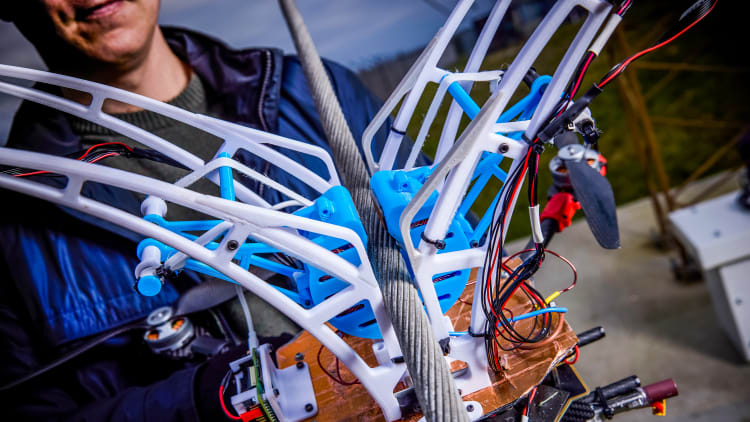
Engineers from the University of Southern Denmark have developed an ingenious technology that enables a drone to fly practically forever, without ever having to return to the ground. Thanks to a docking mechanism, its sensors, and artificial intelligence system, the drone can recognize a power line every time it needs to recharge its batteries, approaching the high-voltage cable, and clinging to it from below, sucking electricity like some kind of electric vampire. “The drones would be able to essentially live on the grid and operate completely autonomously for extended periods of time with no need for human interaction,” the development team explained. The researchers outfitted the drone with grippers, basically an insulated clamp that grabs the power line without conducting electricity to the drone itself. The drone’s software recognizes when the gripper is in the right place and activates an electromagnetic mechanism. (via Fast Company)
Good luck making any sense out of the borders between Belgium and the Netherlands
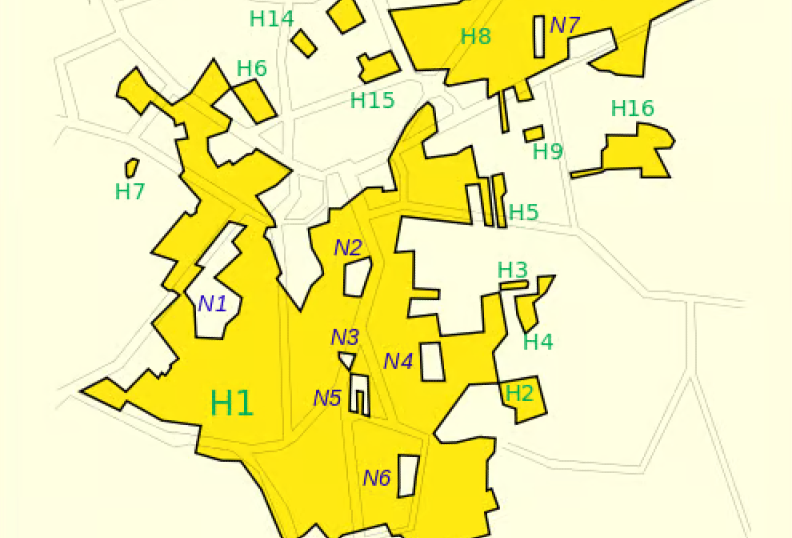
Welcome to Baarle-Hertog, Belgium. Located on the border of Belgium and the Netherlands, the main part of the municipality, called Zondereigen, is tucked neatly within the well-known and obvious borders of the nation. But travel about five miles northeast into the Netherlands, and you'll re-enter Baarle-Hertog, and, by extension, Belgium. And then you'll leave it again, and re-enter, and leave it again, and re-enter, and so on. It's a mess. But not a regular mess – an international one. The detached part of Baarle-Hertog is actually scattered pieces intertwined with a municipality of the Netherlands called Baarle-Nassau. In total, there are about two dozen pieces of Baarle-Hertog, with the largest (excluding Zondereigen) containing six distinct areas of Baarle-Nassau within its limits. The divisions are so minute that some, like the one pictured here, appear no larger than a Little League baseball field. (via Now I Know)
Blind, neurodivergent and playing Chopin's Nocturne in B Flat Minor perfectly

Acknowledgements: I find a lot of these links myself, but I also get some from other places that I rely on as "serendipity engines," such as The Morning News from Rosecrans Baldwin and Andrew Womack, Jodi Ettenberg's Curious About Everything, Dan Lewis's Now I Know, Robert Cottrell and Caroline Crampton's The Browser, Clive Thompson's Linkfest and Why Is This Interesting by Noah Brier and Colin Nagy. If you come across something you think should be included here, feel free to email me at mathew @ mathewingram dot com